UG
Ulrich Gall
The Living Hieroglyphs of Lijiang
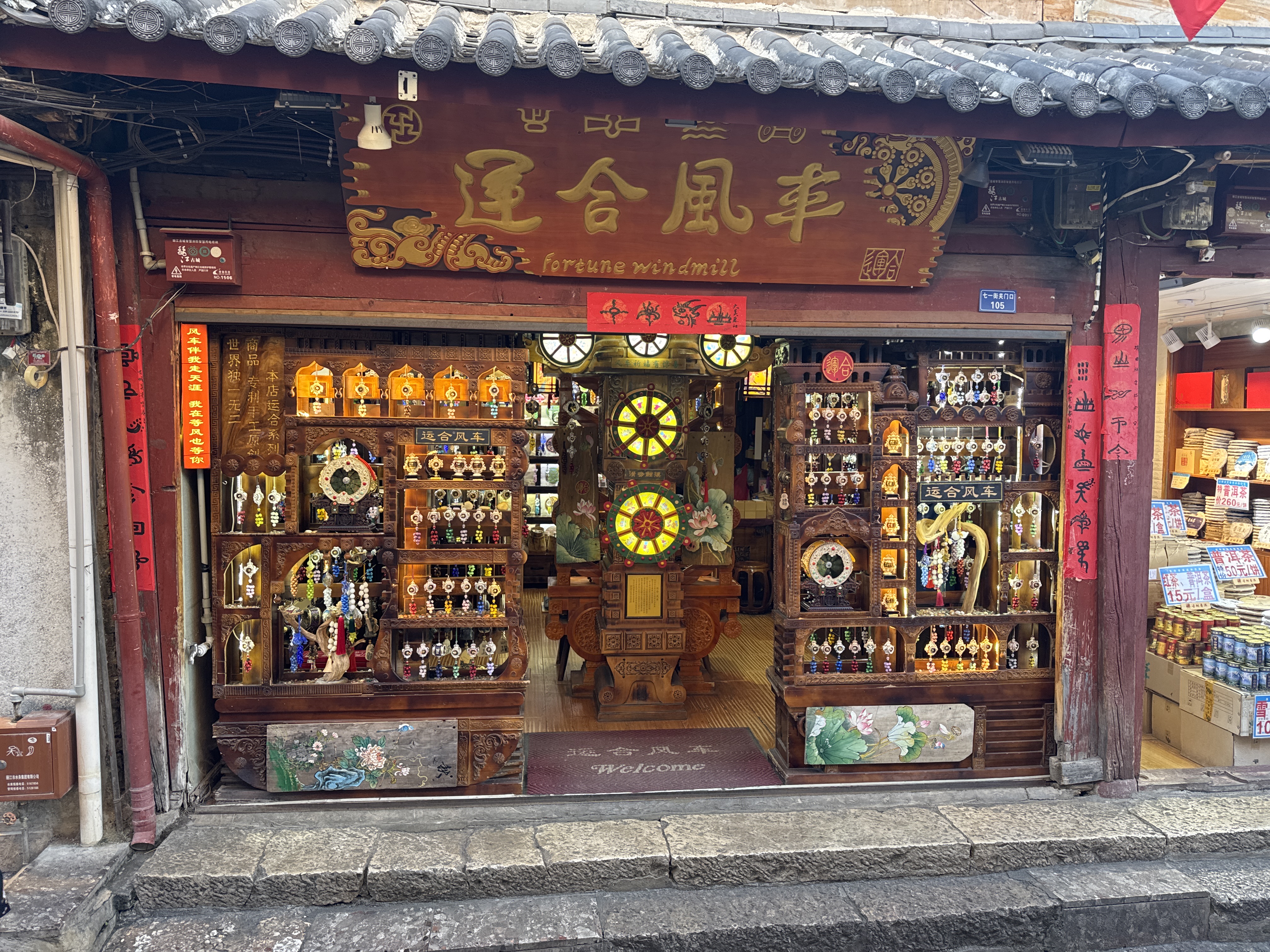
This charming storefront in the Old Town of Lijiang features a specialized craft unique to this high-altitude region of Yunnan: the "Fortune Windmill." While the sign translates it literally, these are more accurately known as Lijiang Wind-Bells or Fortune Wheels. What makes them so distinctive is the script you see carved into the top of the wooden sign and on the red scrolls flanking the door. This is not traditional Chinese, but rather Dongba script—the only hieroglyphic writing system in the world that is still in active use today.
The script belongs to the Naxi people, an ethnic group that has called Lijiang home for over a thousand years. Unlike Chinese characters, which evolved into abstract strokes, Dongba remains a pictographic language where symbols look like the objects they represent. The shop name, *Yunhe Fengche* (运合风车), means "Lucky Windmill," and these objects are deeply tied to local spiritual life. The Naxi believe that as the wind turns these wheels and rings the small bells attached to them, it carries prayers and good wishes up to the spirits of the Jade Dragon Snow Mountain, which towers over the city.
If you look closely at the wooden shelves, you will see rows of colorful, bead-adorned ornaments. These often incorporate symbols of the zodiac or the "Eight Diagrams" of Taoism, blended with Naxi animist traditions. The swastika symbol visible on the white lamp above the door might look jarring to a Westerner, but here it is an ancient Buddhist and Hindu symbol of peace, prosperity, and the sun, frequently seen throughout East Asia.
Lijiang itself is a UNESCO World Heritage site famous for its complex network of canals and cobblestone streets. Because the town was an important stop on the Ancient Tea Horse Road—the high-altitude trade route between Yunnan and Tibet—the local culture became a beautiful mosaic of Han Chinese, Tibetan, and Naxi influences. Shops like this one preserve the Naxi identity, turning the "whispering of the wind" into a tangible piece of art that visitors can take home to catch the breeze in their own gardens.
The Living Hieroglyphs of Lijiang
The script on the red banners and the wooden carvings is Dongba script, the only hieroglyphic writing system still in active use today. It belongs to the Nakhi (Naxi) people, an ethnic group indigenous to the foothills of the Himalayas in Yunnan. Unlike modern alphabets, Dongba is a pictographic mnemonic system; historically, only "Dongba" priests could read it to perform rituals for exorcism or harvest.
The "Fortune Windmill" store specializes in traditional Nakhi wooden craftsmanship and Tibetan Buddhist influence, which are deeply intertwined in Lijiang. The swastika visible on the top left is the *wan* symbol, an ancient sign of auspiciousness and eternal cycle in East Asian traditions, predating and unrelated to 20th-century Western political misappropriation. The colorful items are amulets and prayer wheels, intended to be spun to release prayers into the spiritual world.
Dongba Script and Fortune Wheels of Lijiang
Traditional Naxi architecture in Lijiang Old City houses this shop specializing in "Fortune Windmills" (运合风车), a local syncretic charm combining Buddhist and Taoist symbolism. The central rotating wheels mimic Tibetan prayer wheels (mani chos-'khor), intended to accumulate spiritual merit and harmonize "Feng Shui" (wind-water) energy for the owner.
Note the red vertical banners featuring **Dongba script**, the world’s only surviving actively used hieroglyphic writing system. Used by the Naxi people, these 1,400+ pictograms predate the 10th century and were historically reserved for shamans (Dongbas) to perform exorcisms and life-cycle rituals.
The swastika symbol (万 - wàn) on the top left eaves is the "yungdrung," an ancient Eurasian symbol of eternity and the sun. In this Himalayan-adjacent context, it represents the heart of the Buddha and auspiciousness, entirely unrelated to 20th-century Western political misappropriation. The shop’s intricate woodwork reflects Lijiang's status as a UNESCO site, blending Han Chinese, Tibetan, and Bai ethnic styles.