UG
Ulrich Gall
The Living Pictographs of the Naxi
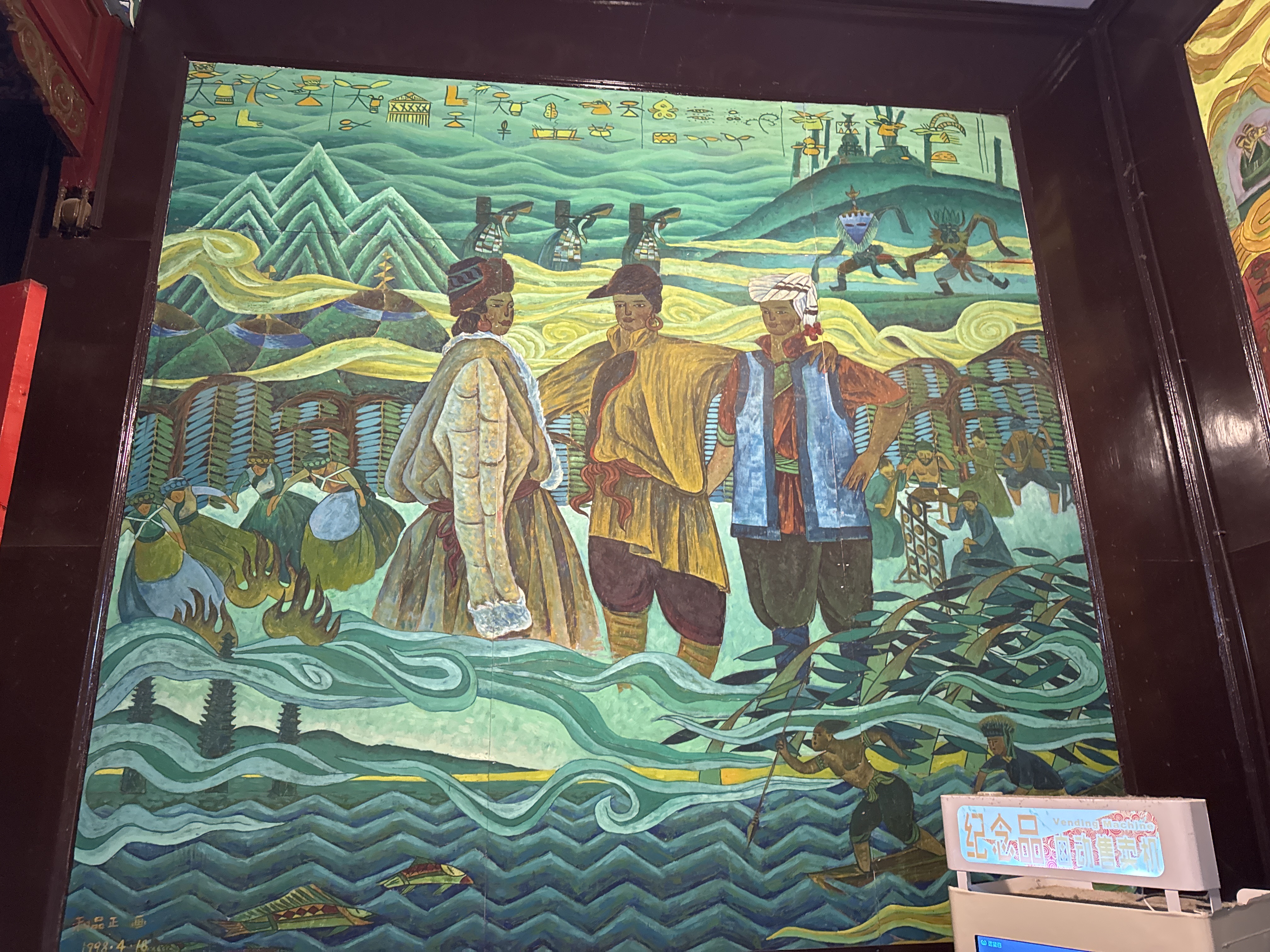
While the symbols at the top of this mural might look like ancient Egyptian hieroglyphs or perhaps even doodles, they are actually part of the only living pictographic writing system in the world today. This is the Dongba script, used by the Naxi people of the Lijiang region. Unlike modern alphabets or even Chinese characters, which have evolved into abstract symbols, Dongba remains highly visual; for instance, the sun is drawn as a literal circle with rays, and a mountain looks like a jagged peak.
The mural itself serves as a cultural tapestry of the Naxi people, who have lived in these mountains for centuries. The figures in the center are wearing traditional Lijiang attire. You might notice the women’s clothing specifically, which often features a sheepskin cape known as the "Seven Stars and the Moon." This symbolizes the Naxi women's legendary diligence—working from the time the stars are out in the early morning until the moon rises at night. The scenes surrounding the figures depict the harmonious, if rugged, life in Yunnan, featuring elements of fishing, farming, and the misty, high-altitude landscapes of the Jade Dragon Snow Mountain range.
The Wangu Tower, where this mural is located, acts as a landmark for the Naxi’s spiritual and architectural heritage. The building itself is constructed entirely of wood without using a single nail, a testament to traditional Chinese craftsmanship. The mural integrates the Dongba script at the top not just as decoration, but as a blessing or a narrative of the scene below. Because the script is so complex—containing over 1,400 characters—it is historically mastered only by "Dongba" shamans, who used it to record ritual texts and legends. Today, it stands as a proud symbol of Lijiang’s status as a UNESCO World Heritage site, bridging the gap between an ancient tribal past and the modern world.
The Living Hieroglyphs of the Nakhi
Wangu Tower serves as a monument to the culture of the Nakhi (Naxi) people, the dominant ethnic group in Lijiang. The symbols visible across the top of this mural are Dongba script, the only living pictographic writing system in the world. Unlike phonetic alphabets, Dongba consists of approximately 1,400 symbols, most of which represent objects or actions directly. It is primarily used by Nakhi priests (Dongba) for religious sutras, and its complexity means it often requires oral tradition to bridge the gaps between symbols.
The figures depicted highlight the Nakhi’s historical role as intermediaries on the Ancient Tea Horse Road, a network of trade routes between Southwest China and Tibet. The distinct clothing styles—ranging from the sheepskin capes of the high-altitude herders to the blue vests typical of the Lijiang basin—reflect the ecological diversity of the region. The central theme of many such murals in this tower is the "Great Harmony," illustrating the coexistence of the Nakhi, Han, and Tibetan people, as well as the syncretic blend of Dongba shamanism, Buddhism, and Taoism that defines local spiritual life.
The Living Hieroglyphs of the Naxi
Traditional Naxi mural inside Wangu Tower. Features **Dongba symbols** at the top—the world's only surviving actively used hieroglyphic writing system. These pictographs are used by Naxi shamans (*Dongba*) for ritual texts; they are more primitive than Chinese characters, functioning as mnemonics for oral literature.
Central figures showcase ethnic diversity in Yunnan: Naxi, Tibetan, and Yi groups. The Naxi are a historically **matrilineal society**. While Lijiang is famous for "walking marriages" (the Mosuo subgroup nearby), the mainstream Naxi are patrilineal but retain high female status; women handle all labor and finances, while men traditionally focused on music, pets, and scholarly pursuits.
Top right depicts a *Dongba* ritual dance to exorcise demons. The landscape reflects the **Jade Dragon Snow Mountain** (seen in the zig-zag peaks). The fusion style combines traditional Tibetan *thangka* palettes with 20th-century Chinese socialist realism. Wangu Tower itself is a 1997 reconstruction, hence the modern vibrant pigments.