UG
Ulrich Gall
The Silent Scar of the San Andreas Fault
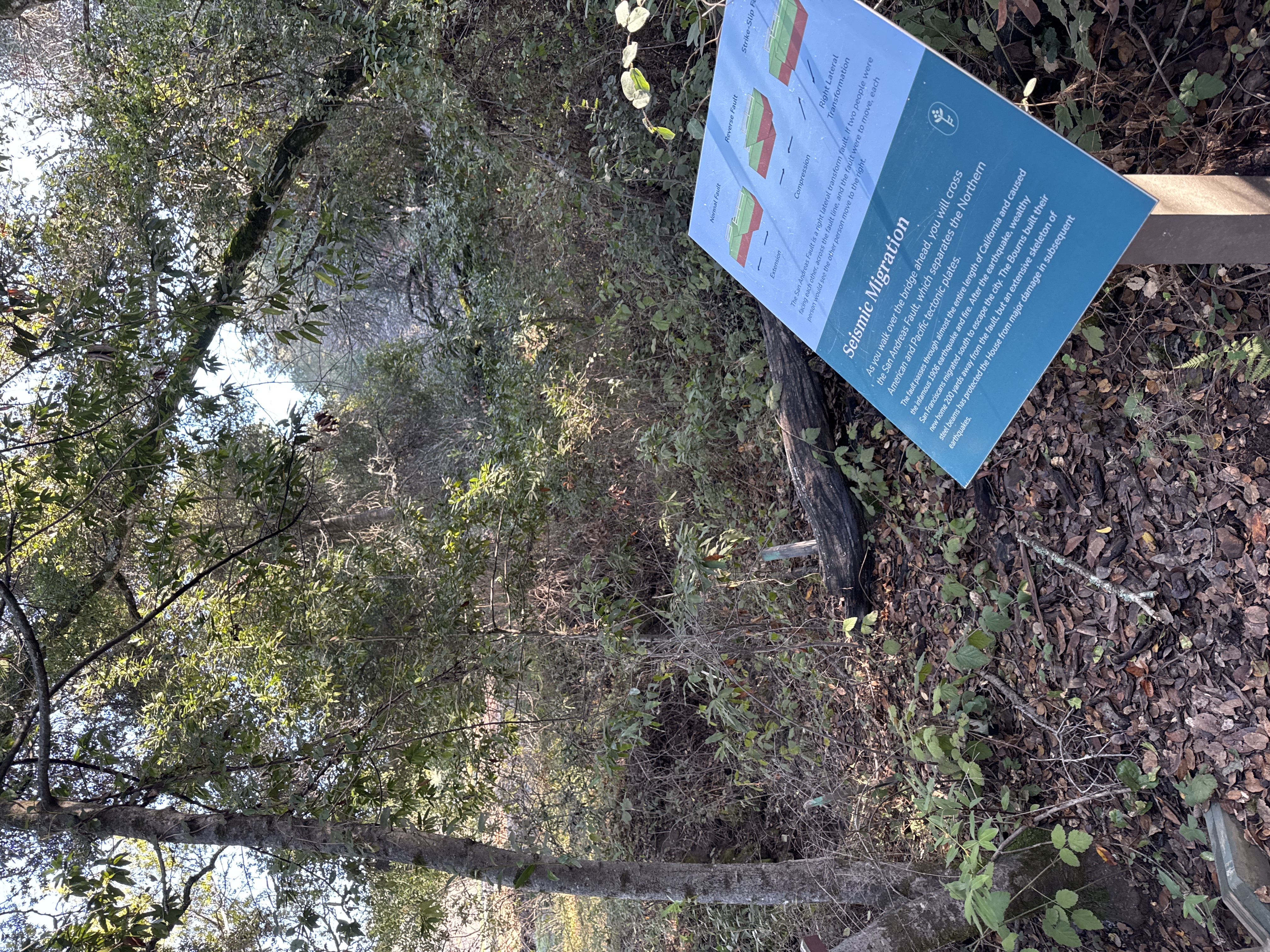
Here, in this desolate stretch of trees and undergrowth, a sign stands, a lonely sentinel. It speaks not of ancient kings or forgotten battles, but of something far more primordial, more terrifying: the very restless skin of our planet. "Seismic Migration," it proclaims, a phrase that evokes images of subterranean beasts stirring from their slumber, moving with an almost human intent.
You see, beneath this seemingly tranquil forest floor, lies a scar. A monumental fracture known as the San Andreas Fault. It is not merely a crack in the rock; it is the brutal boundary where two colossal plates of the Earth's crust, the North American and the Pacific, grind against each other in an eternal, agonizing dance. Like estranged lovers, locked in a perpetual embrace of friction and release, they reshape the very landscape with an indifference that borders on cruelty.
This sign, this humble piece of metal and plastic, it tells us that as one traverses merely a simple bridge nearby, one crosses this titanic divide. Imagine it: walking across a line that bisects continents, a geological caesura. The 1906 San Francisco earthquake, a cataclysm that scorched memory into the collective consciousness, was but a violent spasm of this unseen struggle. It drove the wealthy to flee south, escaping the shattered city. The Bourns, for example, built their new home 200 yards from the fault. Two hundred yards, a mere trifle against the vastness of geological time and power. Yet, their house, fortified with a skeleton of steel, survived. A testament, perhaps, to human ingenuity, or perhaps, simply a momentary reprieve from the inevitable, a whisper of defiance against the relentless, indifferent forces of plate tectonics. The earth beneath us, it moves. Always. A slow, silent process, until it is not.
Standing on the San Andreas Fault
You’re standing in a spot that offers a subtle yet profound lesson in geology, as you’re right on the very edge of the San Andreas Fault, one of the most famous and active geological features in the world.
This fault is a "right-lateral transform fault," meaning that the land on either side of it is sliding past each other horizontally. If you were standing on one side and a friend on the other, you'd both be moving to your right relative to each other. This immense geological seam separates two colossal pieces of the Earth's crust: the North American Plate and the Pacific Plate. The fault stretches for nearly the entire length of California, and it's the primary reason for California's frequent earthquakes.
The most infamous event caused by the San Andreas Fault was the 1906 San Francisco earthquake and subsequent fire. This devastating disaster led to a significant migration of wealthy San Franciscans who sought safer ground to the south. You can learn about one such family, the Bourns, who built a new home just 200 yards from the fault. Cleverly, they incorporated an extensive steel skeleton into their house's construction, which has protected it from major damage in all the earthquakes since. This fascinating detail shows how humans have ingeniously adapted to living in such a seismically active zone.
Crossing the San Andreas Fault at Paul Creek Bridge
You're on the Paul Creek Bridge, which is a surprisingly significant spot because you're literally crossing the San Andreas Fault here. This fault is a major boundary between the Pacific and North American tectonic plates, responsible for California's frequent seismic activity, including the devastating 1906 San Francisco earthquake. The sign mentions how wealthy San Franciscans migrated south after that disaster, with some, like the Bourns, building earthquake-resistant homes, even if just 200 yards from the fault line, demonstrating an early awareness of seismic engineering.
San Andreas Fault Marker at Paul Creek Bridge
This educational sign, titled "Seismic Migration," marks the **San Andreas Fault**, a massive right-lateral transform fault separating the **North American and Pacific tectonic plates**.
The fault runs beneath Paul Creek Bridge. The 1906 San Francisco earthquake, which caused widespread fire and damage, was caused by movement along this fault.
The sign details a unique post-1906 event: wealthy San Franciscans migrating south after the disaster. The Bourn family built their new home 200 yards from the fault and structurally reinforced it with steel beams, mitigating damage from later earthquakes. The fault type here is a **right-lateral transform fault** where plates slide past each other horizontally.