UG
Ulrich Gall
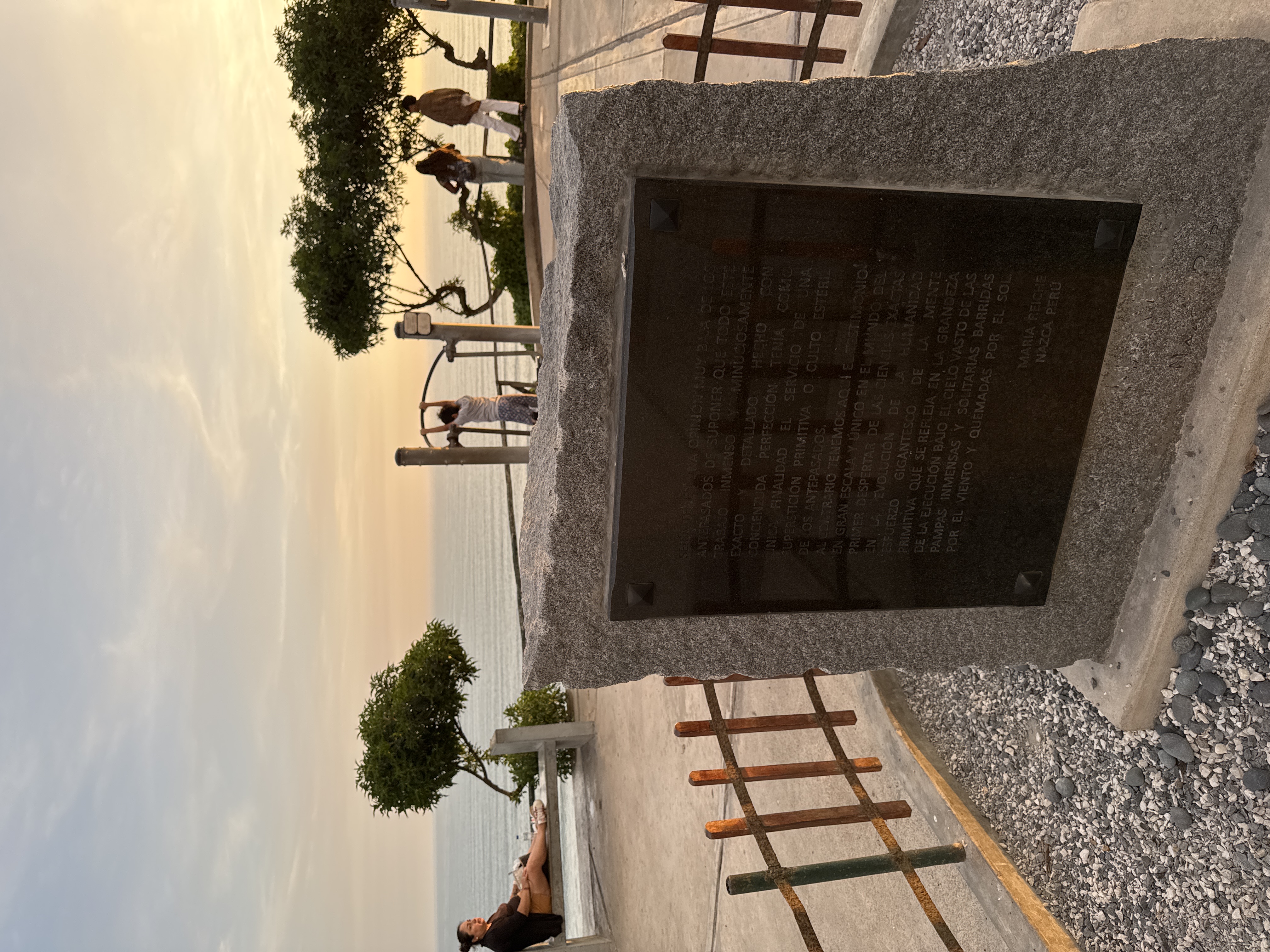
Maria Reiche Memorial Plaque
Perched on the cliffs overlooking the Pacific Ocean in Lima, you've captured a poignant tribute to a remarkable woman and an enduring mystery. The stone plaque you see here is a memorial dedicated to Maria Reiche, often called "the Lady of the Lines" or "the Lady of the Nazca Lines."
The text on the plaque, translated from Spanish, speaks to a profound understanding of ancient civilizations that challenges common perceptions. It reads:
"Our ancestors lead us to believe that all this immense, meticulously exact, and detailed work, carried out with conscious perfection, had as its sole purpose the service of a primitive superstition or sterile cult of the ancestors. On the contrary, here we have testimony, on a grand scale and unique in the world, of the first awakening of the exact sciences in the evolution of humanity, of the gigantic effort of the primitive mind reflected in the grandeur of the execution under the vast sky of the immense and solitary pampas swept by the wind and burned by the sun. Maria Reiche, Nazca, Peru."
This inscription encapsulates Maria Reiche's life work and her deep respect for the ancient Nazca people. For over 40 years, this German mathematician and archaeologist dedicated herself to studying, preserving, and drawing attention to the Nazca Lines in Peru. These colossal geoglyphs, etched into the desert floor hundreds of years ago, depict animals, plants, and geometric shapes, some stretching for miles.
When many in the academic world dismissed the Nazca Lines as crude primitive art or ritualistic symbols, Reiche saw them as something far more sophisticated. She believed they were a monumental astronomical calendar, used by the Nazca people to track celestial events and predict agricultural cycles. Her meticulous work involved mapping, cleaning, and protecting these fragile formations, often working alone in the harsh desert environment. She lived in a humble house nearby and became a familiar, almost legendary, figure in the region.
The "immense and solitary pampas" mentioned in the inscription refer to the Nazca desert plain, about 250 miles southeast of Lima, where these enigmatic lines are located. The plaque's description of the "first awakening of the exact sciences" and the "gigantic effort of the primitive mind" perfectly echoes Reiche's belief that the Nazca people possessed advanced mathematical and astronomical knowledge.
So, while you're enjoying the beautiful coastal view in Lima, this plaque serves as a powerful reminder of one woman's unwavering dedication to uncovering the genius of an ancient civilization and her pioneering spirit in challenging prevailing historical narratives.
---
Maria Reiche's Tribute to Nazca Lines
The inscription you've captured is a tribute to Maria Reiche, a German mathematician and archaeologist famous for her research into the Nazca Lines in Peru. She dedicated over 40 years of her life to studying and preserving these enormous geoglyphs, which are etched into the desert floor. Her work was instrumental in proving that the lines were not random drawings, but rather a sophisticated system, possibly related to astronomical calendars or rituals, demonstrating an advanced understanding of geometry and engineering by the Nazca people. The text emphasizes that these creations were not merely a product of "primitive superstition" but rather evidence of humanity's "first awakening of exact sciences."
The Nazca Lines, found in the Nazca Desert in southern Peru, consist of hundreds of individual designs, ranging from simple lines to stylized hummingbirds, lizards, monkeys, pelicans, and human figures. Many are so large they can only be truly appreciated from an aerial perspective. Their original purpose remains a subject of ongoing debate and fascination among scholars.