UG
Ulrich Gall
The Magenta Invader of the California Coast
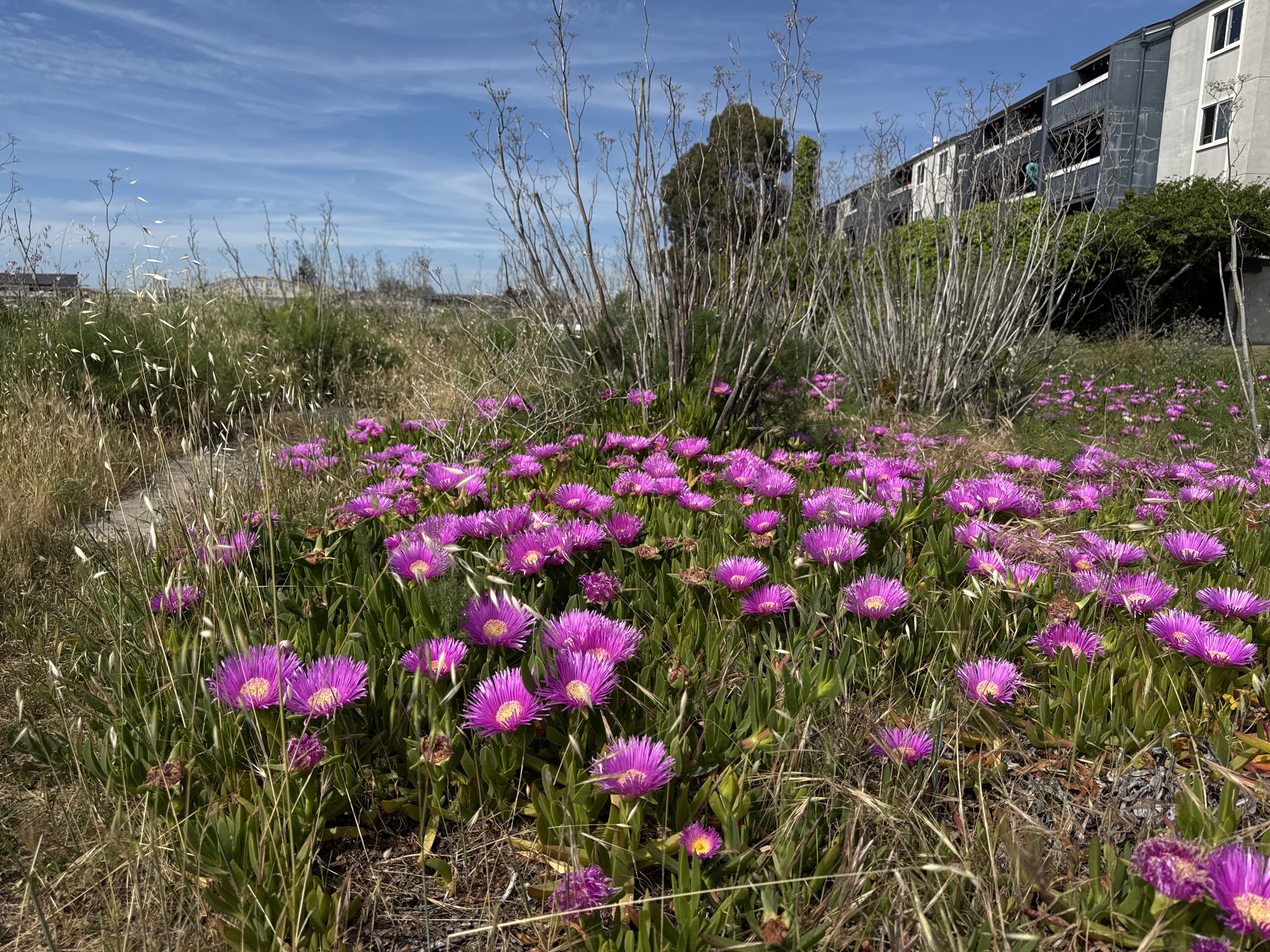
What looks like a vibrant, welcoming carpet of magenta flowers is actually one of California’s most successful botanical invaders: the Ice Plant, specifically the species *Carpobrotus edulis*. While these "sea figs" offer a stunning burst of color against the coastal landscape of Alameda, they tell a complex story of human intervention and ecological consequences.
Originally native to South Africa, Ice Plants were brought to California in the early 1900s for a very practical reason: soil stabilization. Because of their thick, succulent leaves and deep, matting root systems, they were planted extensively along railroad tracks and later by Caltrans along highways to prevent erosion. They are incredibly hardy, capable of thriving in salty air and poor soil where other plants would wither.
However, their strength is also their danger. As a "mat-forming" succulent, the Ice Plant spreads aggressively, creating a dense monoculture that physically crowds out California’s native dune vegetation. This has a ripple effect on the local ecosystem; native plants provide specific habitats for local insects and birds that the Ice Plant cannot replicate. Furthermore, while they were intended to stop erosion, their heavy, water-filled leaves can actually become so weighty during heavy rains that they pull down the very soil they were meant to hold, occasionally contributing to the slumping of coastal bluffs.
In areas like the San Francisco Bay, you’ll often see these plants growing alongside "volunteer" grasses and shrubs in transitional zones between urban housing and the shoreline. While many conservation groups now work to remove them to make room for native poppies and lupines, they remain a quintessential, if controversial, part of the California coastal aesthetic.
The Invasive Beauty of the Ice Plant
These vibrant magenta flowers belong to the **Ice Plant** (*Carpobrotus edulis*), a succulent native to South Africa. While they are a ubiquitous sight along the California coast, they are an aggressive invasive species. Originally introduced in the early 20th century to stabilize soil along railroad tracks and highways, they have since overwhelmed native ecosystems.
Ecologically, they are "salt-accumulators." They pull salt from the soil and concentrate it in their leaves; when the plant dies, the salt is released back into the earth, making the soil toxic to many native California plants. Furthermore, their heavy, water-filled mats can actually increase the risk of land slumps on cliffs rather than preventing them, as the sheer weight of the succulent carpet pulls the top layer of soil down during heavy rains.
The location in Alameda sits on the edge of the San Francisco Bay, an area highly sensitive to these "biological pollutants" which displace the few remaining native marsh and dune species.
The Beautiful Invader: Ice Plant
Bright magenta flowers of the **Ice Plant** (*Carpobrotus edulis*). Native to South Africa, introduced to California in the early 1900s for erosion control along railroad tracks. Now a notorious "invasive alien."
While beautiful, it’s an ecological hazard. Its succulent leaves store salt, which it leaches into the soil as it dies, making the ground toxic for native California plants—a process called "salt enrichment." It forms dense mats that physically "smother" local species and alter the soil pH.
In the Bay Area, it thrives in sandy coastal soils. It is edible; the fruit is reportedly salty and sour, sometimes compared to a salty fig, and the leaves have been used medicinally for skin conditions and even as a mild antiseptic for throat infections. Ironically, despite being planted for stability, its heavy, water-filled leaves can actually cause soil slumping on steep hillsides during heavy rains.