UG
Ulrich Gall
The Entropic Meter of Isla Naos
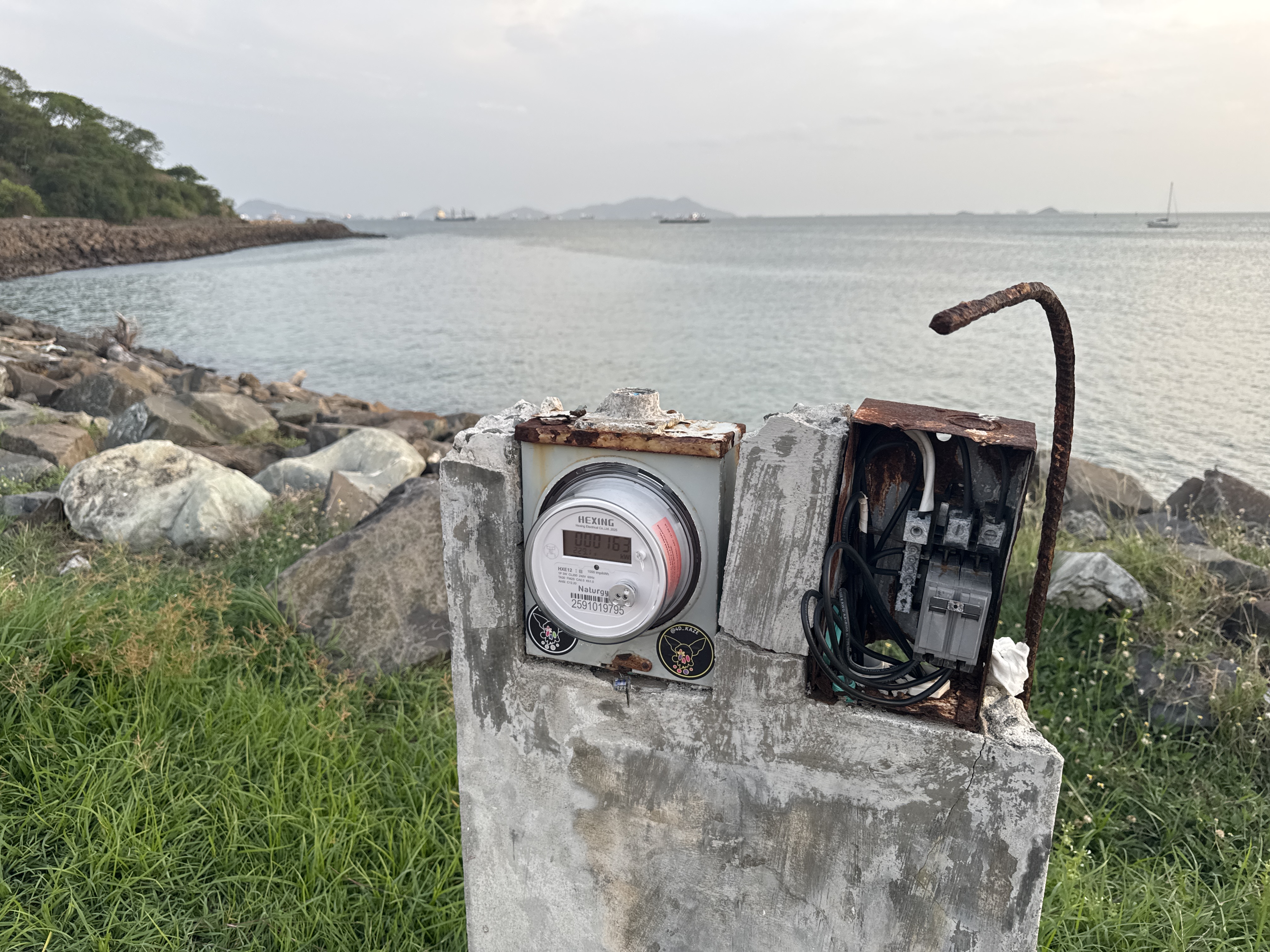
Here, on the edge of the Pacific, where the great vessels queue in a line of industrial indifference to enter the Panama Canal, we find a monument to the futility of human infrastructure. It is a lonely electrical meter, a Hexing single-phase device, clinging to a slab of concrete that nature is slowly reclaiming through the relentless progress of salt and rot.
Look closely at the dial. It counts. It measures the flow of electrons—perhaps for a nearby pier or a lamp that no longer shines—with a digital coldness that ignores the vast, overwhelming scale of the ocean behind it. To its right, a rusted breaker box gapes open like a wound. Its innards are exposed to the elements; the wires are tangled in a chaotic embrace, a "vile obscenity" of copper and plastic struggling against the inevitable corrosion of the sea air. A single piece of rebar reaches toward the sky like a skeletal finger, warning us of the precariousness of our electrical dreams.
This is the Amador Causeway, a land bridge built from the very rocks excavated during the creation of the Canal. It is a place of transit, where tourists walk and ships wait, but here, in this small, decaying junction, we see the true face of the universe. It is not one of harmony, but of a quiet, creeping entropy. The meter continues its silent vigil, recording the energy consumed in a world that is, quite frankly, indifferent to its measurements.
Infrastructure at the Gateway of the Americas
The Amador Causeway is built from the very earth that once blocked the passage between two oceans—it was constructed using rock excavated during the creation of the Panama Canal. Today, it serves as a scenic bridge connecting the mainland to four small islands, but it also hosts remnants of the infrastructure required to maintain this narrow strip of reclaimed land. Even in a place of natural and engineering wonder, the mundane requirements of a modern city, like utilities, are constantly battling the elements.
This particular utility installation belongs to Naturgy, one of the primary electricity distributors in Panama. While it might look surprisingly exposed, the digital meter inside is a modern "Hexing" model, common in Latin America for its ability to handle tropical humidity and provide remote readings. The weathered concrete block and rusting metal casing are a testament to the intense "salitre," or salt spray, that characterizes the Panamanian coast. This corrosive environment is a constant challenge for local infrastructure; metal that isn't meticulously maintained can degrade in just a few years.
At the entrance to the Panama Canal, you are standing at one of the most important maritime crossroads in the world. The calm water in the background is the Pacific entrance to the Canal, and the ships visible on the horizon are likely waiting their turn to transit the locks. The juxtaposition of a high-tech digital electric meter embedded in a crumbling, salt-worn concrete pedestal captures the essence of Panama City: a rapidly modernizing hub where advanced technology lives side-by-side with the rugged, wearing force of the tropical environment.
Infrastructure of the Amador Causeway
The Amador Causeway was constructed in 1913 using rock excavated during the building of the Panama Canal, specifically from the Culebra Cut. This six-kilometer road connects the mainland to four islands: Naos, Perico, Culebra, and Flamenco. During the 20th century, this area was part of a U.S. military installation known as Fort Grant, intended to protect the Pacific entrance of the Canal with heavy coastal artillery.
The electrical infrastructure visible is managed by Naturgy (formerly Gas Natural Fenosa), the primary utility provider in this region of Panama. On Isla Naos, such utility meters often serve the Smithsonian Tropical Research Institute (STRI) facilities or the nearby marinas. The extreme corrosion is a result of the high salinity and humidity of the tropical marine environment, which degrades industrial components significantly faster than in temperate climates. The ships visible in the distance are waiting to enter the Panama Canal’s Pacific access channel, or "anchorage," where vessels often queue for days before their scheduled transit through the Miraflores Locks.
Infrastructure at the Canal's Edge
Hexing smart meter and breaker box on the Amador Causeway. Primarily used to power nearby installations on the landfill-built causeway—constructed from 1.25 million cubic yards of rock excavated during the original Panama Canal construction (1904–1914).
The meter is labeled "Naturgy," the Spanish multinational utility controlling the local grid. In the background: the Pacific entrance to the Panama Canal. Ships visible are likely queued in the "Pacific Anchorage," waiting for their scheduled transit (northbound) through the Miraflores Locks. Transit slots are auctioned; "Neopanamax" ships can pay over $1M for a single passage. Recent drought conditions in Gatun Lake have caused significant backlog and "ghost bookings" in this area.
The exposed wiring and rusted rebar are common tropical maintenance issues. Salt spray from the Bay of Panama accelerates corrosion on infrastructure despite recent multi-million dollar refurbishments of the pedestrian and cycle paths.