UG
Ulrich Gall
The Synthetic Horizon of the Amador Causeway
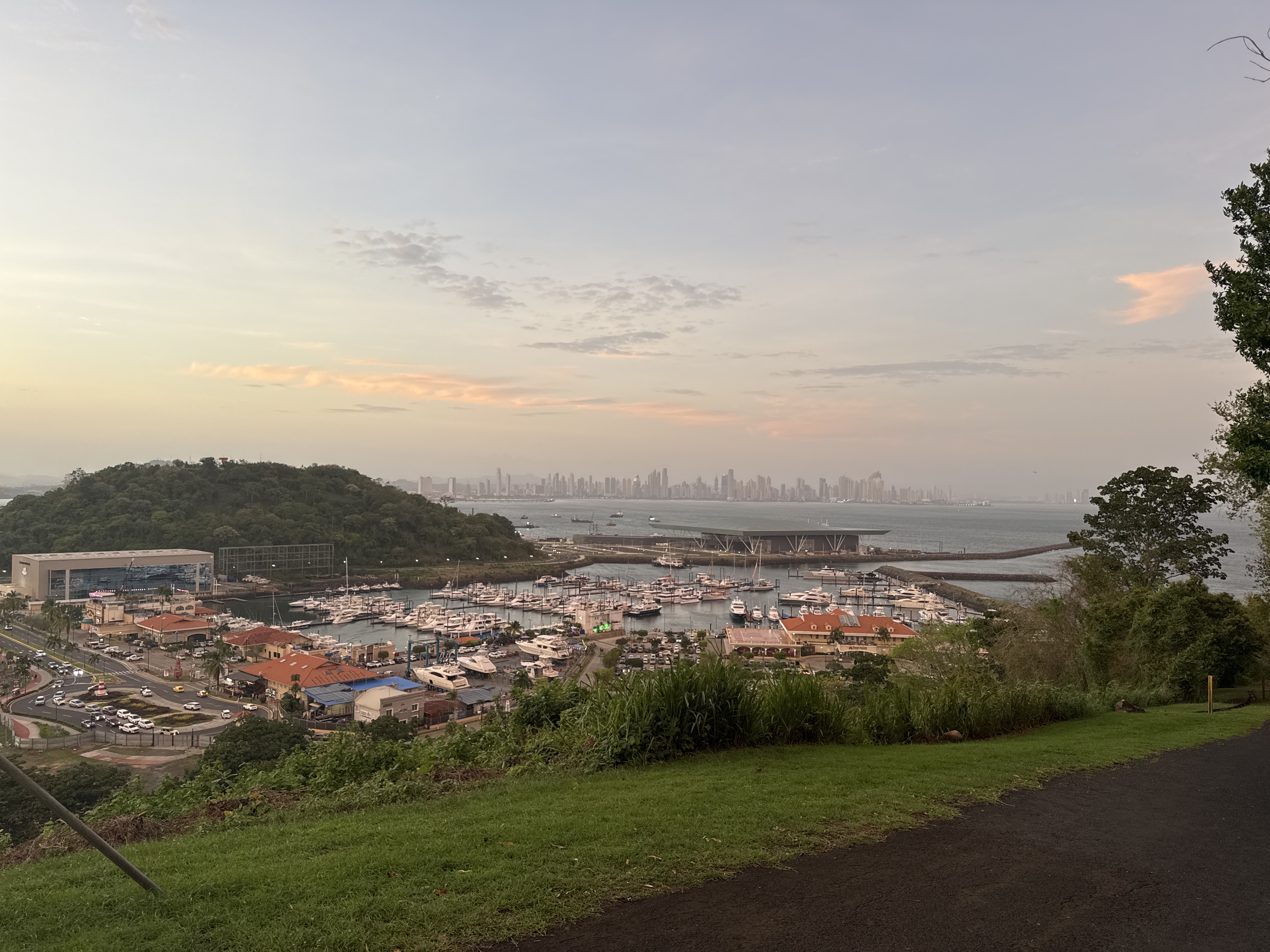
Here, at the edge of the American continent, we gaze upon the Amador Causeway, a terrestrial umbilical cord stretching into the Pacific. It is a monumental vanity of engineering, constructed from the very rocks excavated during the carving of the Panama Canal—a scar upon the earth transformed into a promenade for the aimless wandering of pedestrians and the slow, rhythmic crawl of automobiles.
Below lies the Flamenco Marina on Isla Naos, where white vessels huddle together like bleached bones in a graveyard of leisure. These yachts, symbols of a desperate human urge to conquer the indifferent sea, bob silently in the tide. They are nestled beside the Fuerte Amador Mall, a cathedral of commerce where people exchange their fleeting currency for plastic trinkets, all while the primary gateway to the great canal looms nearby, indifferent to their small desires.
In the distance, the skyline of Panama City rises like a fever dream of glass and steel, shimmering through the tropical haze. It is a vertical forest of capital, standing in stark contrast to the thick, ancient greenery of the hills. This causeway was once a strategic military fortification, a place of cannons and discipline; now, it is a place where one eats ice cream and stares at the horizon, contemplating the overwhelming burden of existence and the relentless passage of enormous container ships that dwarf our collective imagination.
The Gateway to the Pacific
The land stretching out before you is a physical testament to the engineering marvel that is the Panama Canal. The Amador Causeway was constructed using rocks and soil excavated during the original digging of the canal over a century ago. It serves a functional purpose as a breakwater, protecting the entrance of the canal from silt and heavy currents, but it has since transformed into one of the city’s most popular social and recreational hubs.
Looking toward the marina on Isla Naos, you can see how this area blends Panama's role as a global maritime capital with its modern luxury. The boats anchored here range from local fishing vessels to international superyachts waiting for their turn to transit the canal or exploring the nearby Las Perlas archipelago. In the distance, the dramatic skyline of Panama City rises like a tropical Version of Manhattan. This architectural silhouette is unique in Central America; the city boasts some of the tallest skyscrapers in the world, a result of the massive economic boom driven by the canal’s expansion and Panama’s status as a regional financial center.
One of the most striking structures on the edge of the water is the Biomuseo, recognizable by its brightly colored, fragmented roof designed by the world-renowned architect Frank Gehry. It was his first design in Latin America, and it purposefully mimics the tectonic shifts that occurred millions of years ago when the Isthmus of Panama rose from the sea. That event didn't just create this land; it changed the world’s climate and biodiversity by separating the Atlantic and Pacific oceans, a story that defines the very ground you are standing on.
The Amador Causeway and Fort Grant
The Amador Causeway was constructed in 1913 using rock extracted during the excavation of the Culebra Cut for the Panama Canal. It links the mainland to four islands—Naos, Perico, Culebra, and Flamenco—and originally served as a strategic military breakwater to protect the canal entrance from silt and Pacific currents.
During the 20th century, this area was part of Fort Grant, a high-security U.S. military installation designed to defend the canal with massive coastal artillery. These islands were once strictly off-limits to Panamanians, symbolizing the territorial tension of the Canal Zone. Following the Torrijos-Carter Treaties, the land was transferred to Panama in 1999 and transformed into a leisure destination.
The large, flat-roofed structure near the water is the Panama Convention Center, a key element of the city's recent multi-billion dollar waterfront expansion. Beyond the marina, the high-rise skyline of Panama City represents the "Dubai of Latin America," a hub for international banking and maritime trade, though the city's rapid vertical growth has historically been linked by international observers to large-scale money laundering and the reinvestment of "offshore" capital.
Engineering Marvels of the Amador Causeway
Amador Causeway: built 1913 using 1.25 million cubic yards of rock excavated from the Culebra Cut during Canal construction. Originally a strategic U.S. military link for Fort Grant to defend the Pacific entrance.
Fuerte Amador Marina (visible below) serves as a hub for deep-sea fishing and private yachts. The prominent flat-roofed structure is the Panama Convention Center, a $193 million Chinese-funded project (China Construction America).
The skyline in the distance—the "Dubai of Latin America"—features the JW Marriott (formerly Trump Ocean Club), once the tallest building in Latin America. Much of this real estate boom was fueled by Panama’s status as a tax haven and favorable residency-by-investment laws. The islands themselves (Naos, Perico, Flamenco) were once isolated; the Causeway’s breakwater function prevents silt from the Bay of Panama from clogging the Canal's channel.
The area is notorious for "money laundering architecture": glittering skyscrapers that remain largely vacant, serving as vertical bank accounts for international capital.