TF
Tobin Fricke
The Shanghai Marriage Market
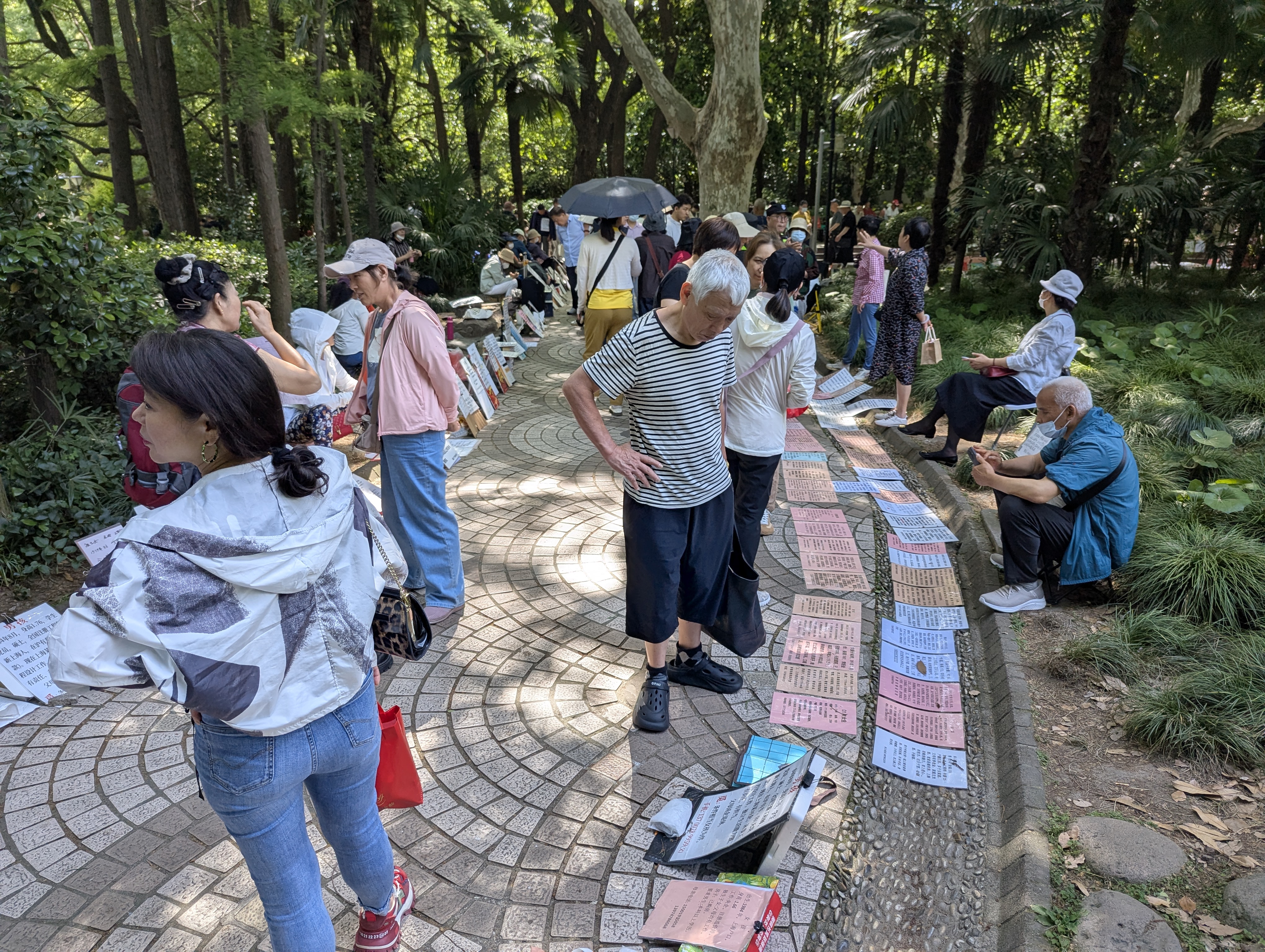
Here, in the heart of public gardens like People's Park in Shanghai, we witness a most peculiar manifestation of human desperation and biological urgency. It is known as the Marriage Market.
Notice how the parents, these aging guardians of the genetic line, sit in grim silence or engage in hushed, transactional negotiations. They have laid out colorful laminated sheets upon the cold stone, forming a long, winding path of human longing. These papers do not contain poetry or grand philosophical inquiries; they are cold inventories of the soul—height, weight, salary, zodiac sign, and the ownership of apartments. Each sheet is a desperate advertisement for a child who is often not even present, a son or daughter too busy working in the tall, indifferent towers of the city to find their own mate.
The atmosphere is heavy with the weight of Confucian duty and the crushing pressure of societal expectation. Watch the man in the striped shirt as he gazes down at these papers with a look of profound existential weariness. He is not merely looking for a daughter-in-law; he is struggling against the inevitable fading of his own lineage.
In this verdant jungle, the trees provide a deceptive tranquility, while underneath their canopy, a brutal audit of human value takes place. It is a stock exchange of the heart, where 'years of birth' and 'square meters of property' are the only currencies that carry any weight. Here, love is not a feverish dream or a sudden strike of lightning, but a calculated acquisition, scrutinized by the sharp, unforgiving eyes of the elders.
The Shanghai Marriage Market
While this may look like a casual outdoor market, you are actually witnessing a deeply traditional and highly organized "Marriage Market," most likely the famous one located in Shanghai’s People’s Park. Here, it isn't goods for sale, but rather the qualifications of eligible bachelors and bachelorettes. The rows of papers and placards lining the walkways are essentially physical Tinder profiles, or "marriage resumes," meticulously laid out by concerned parents and grandparents looking for suitable partners for their children.
The interesting twist is that the children themselves are rarely present. In modern Chinese society, young professionals are often so consumed by the "996" work culture—working from 9:00 AM to 9:00 PM, six days a week—that they have little time to date. Their parents, feeling the pressure of traditional Confucian values that emphasize marriage and lineage, take matters into their own hands. These signs typically list the "stats" that are considered vital for a stable provincial match: age, height, education level, job, salary, and most importantly, whether the individual owns an apartment or holds a local *hukou* (residency permit), which grants access to schools and social services.
If you look closely at the text on the cards, like the pink one in the foreground, you’ll see headings like "男" (Male) or "女" (Female). Underneath, they detail specific requirements. For instance, the sign on the bottom right mentions a birth year of 1994, a height of 176cm, and notes about the person's professional design work and "stable income." You will often see parents sitting nearby on folding chairs, ready to interview potential in-laws. It functions as a blend of a social club for the elderly and a serious brokerage. While the success rate for actual marriages resulting from these markets is famously low, the ritual remains a significant cultural phenomenon, highlighting the generational gap between China’s traditional family expectations and the fast-paced reality of its modern urban youth.
Shanghai Marriage Market
Shanghai Marriage Market, held weekends at People's Park. Parents "advertise" unmarried children via handwritten resumes taped to umbrellas or paths. Listings detail height, salary, zodiac sign, education, and property ownership. Key term: "Sheng nu" (leftover women), target age 27+.
Stark manifestation of China's demographic crisis and gender imbalance. Parents frequently bypass their children's consent to find "compatible" matches, prioritizing financial stability over romance. High tension between traditional filial piety and modern individualism. Urban property ownership (hukou) is the ultimate bargaining chip here.
Location information is still being resolved.