UG
Ulrich Gall
The Heart of Panama City's Mercado de Mariscos
The Mercado de Mariscos, or Seafood Market, is a cornerstone of daily life in Panama City, famously sitting at the edge of the historic Casco Viejo and the modern skyline. While it is best known for its legendary ceviche stalls outside, the interior is a high-energy hub where the city’s culinary backbone is on full display.
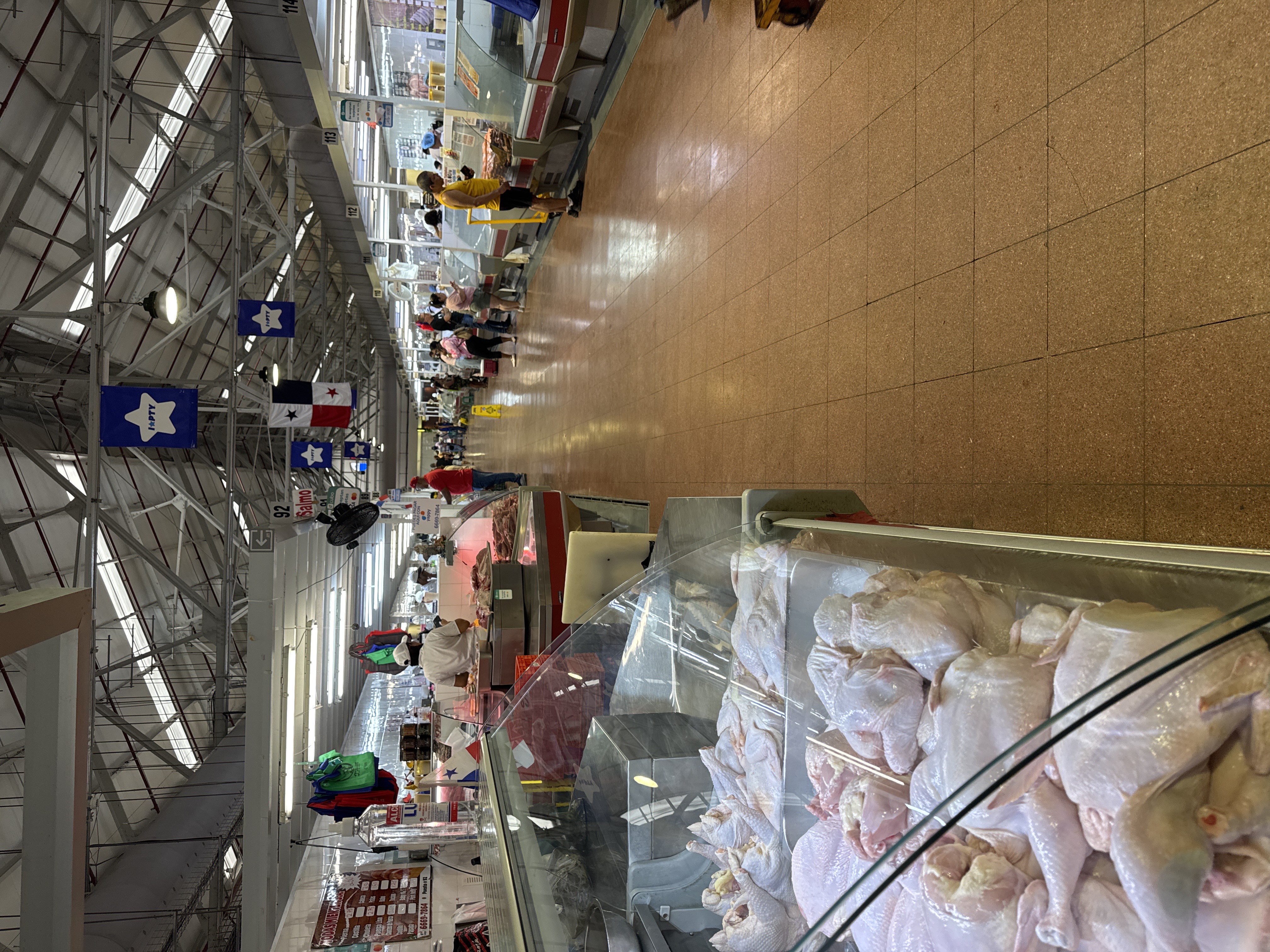
One of the first things that might strike a visitor from North America or Europe is the presence of poultry and meat stalls, like the ones with neatly arranged whole chickens, right alongside the fresh catch of the day. While the building is primarily known for seafood, it serves as a more comprehensive "Mercado Público" for the surrounding neighborhood of Santa Ana. The blue banners hanging from the rafters featuring a white star and the text "I ❤️ PTY" use the international airport code for Panama City, "PTY," which has become a ubiquitous symbol of local pride and shorthand for the city itself.
The environment here is a masterclass in local logistics. Notice the red and white price lists and the numbered stalls, such as stall 92 advertising "Salmo" (Salmon). Unlike a sanitized supermarket experience, this is a place where chefs from the city’s top restaurants rub shoulders with local families. The sanitation is taken seriously, evidenced by the large bottles of hand sanitizer and the industrial fans used to keep the air moving in the tropical humidity.
The market was actually a gift from the Japanese government in the 1990s, built to help modernize the city's fishing industry. This international influence is why the facility feels more organized and industrial than many other Latin American open-air markets. Because the market is situated right next to the docks where the fishing boats come in, the seafood—especially the Corvina (sea bass), which is the star of Panamanian ceviche—is often less than a few hours out of the water.
Panama City's Seafood Hub
The Mercado de Mariscos (Seafood Market) is the pulse of Panama City’s culinary scene. While the first floor is a bustling wholesale and retail hub for the daily Pacific catch brought in by local fishermen, the second floor houses numerous small restaurants serving *ceviche*—fresh raw fish cured in citrus juices—which is a staple of Panamanian street food.
Panama’s "Barrio Chino" (Chinatown) is one of the oldest in Latin America, dating back to the mid-19th century when Chinese laborers arrived to work on the Panama Railroad and later the Canal. The proximity of the seafood market to this district reflects the deep historical integration of Chinese-Panamanians in the local commerce and food industry.
The presence of high-quality poultry and meat alongside specialized seafood indicates the market's role as a comprehensive wet market for both the local Afro-Caribbean and Hispanic populations. In Panama, the government often regulates the price of basic food staples through a "Canasta Básica" (Basic Basket) policy to ensure affordability, which explains the high volume of local shoppers here compared to more tourist-oriented supermarkets.
The Pulse of Panama's Barrio Chino
Located in the Santa Ana district, the Mercado de Mariscos (Seafood Market) is the pulse of Panama City’s culinary scene. While the stalls display various local catches, the area around Barrio Chino is culturally significant as one of the oldest Chinese neighborhoods in Latin America. Chinese immigrants arrived in the mid-19th century to build the Panama Railroad and later the Canal; today, their influence permeates local logistics and food.
In markets like this, look for "Corvina" (sea bass), a local staple often prepared as ceviche with lime and habanero. Beyond the stalls, the nearby "Calle Carlos A. Mendoza" is famous for unlicensed, high-stakes street gambling and specialized botanicas selling Santería supplies—ritual candles, "healing" oils, and cigars for cleaning spirits. The industrial-style architecture, with high gabled roofs and open sides, is a classic tropical design to maximize airflow and combat the oppressive humidity without reliance on expensive HVAC systems.