UG
Ulrich Gall
Gallina de Patio and Unlaid Eggs
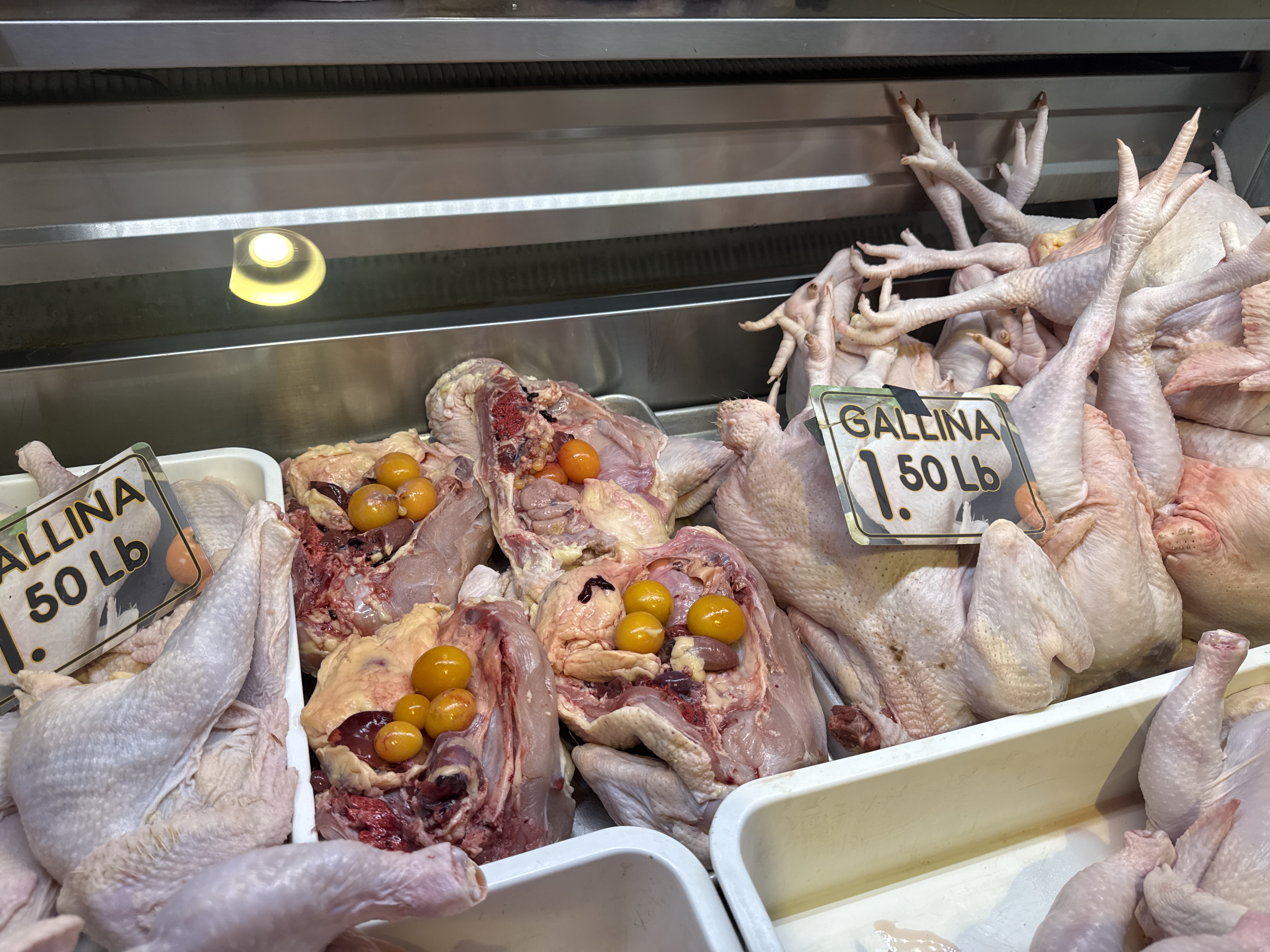
While at first glance these might look like small citrus fruits or decorative garnishes tucked inside the poultry, you are actually looking at a prized culinary delicacy known as unlaid eggs, or "yemas." In Panama and much of Latin America, there is a distinct culinary difference between "pollo"—the young broiler chickens typically found in Western supermarkets—and "gallina de patio," which are older, free-range hens.
The signs labeled "Gallina" refer to these mature hens, and the price of $1.50 per pound reflects their status as a specialty item. Because these birds are older and free-range, their meat is much tougher and leaner than a standard chicken; however, they are famous for having a significantly deeper, richer flavor. This complexity makes them the essential ingredient for "Sancocho," Panama’s national soup. A Sancocho made with a standard supermarket chicken is considered a poor imitation compared to one made with a true "gallina."
The bright yellow spheres you see are the yolks found inside the hen at the time of processing. Unlike a laid egg, these have no shell and a remarkably rich, creamy texture once cooked. In Panamanian households and traditional eateries, finding a yema in your soup is often considered a lucky treat. They are simmered directly in the broth, absorbing the flavors of culantro—a pungent herb similar to cilantro—and starchy tropical tubers like ñame.
The presence of the feet still attached to the carcasses is another indicator of traditional preparation. These are included because they are packed with natural collagen, which gives a thick, velvety body to soups and stews that you simply cannot achieve with processed cuts of meat. Seeing the bird presented this way, complete with its internal treasures, is a hallmark of the "nose-to-tail" eating philosophy that remains a vibrant part of daily life in Panama City’s markets.
Unlaid Eggs and Gallina de Patio
The yellow, spherical objects found inside these carcasses are unlaid eggs, often referred to as "embryonic eggs" or *huevos de gallina* in Latin American markets. They are harvested from "stewing hens" (*gallina de patio* or *gallina vieja*), which are older laying hens past their peak egg-production years.
Unlike the commercial, soft-fleshed chickens (*pollo*) common in Western supermarkets, these mature hens have tougher, leaner meat with high connective tissue content, requiring long, slow simmering to become tender. In Panama, they are the essential ingredient for *Sancocho*, the national chicken soup, providing a much richer, deeper yellow broth than younger birds.
The unlaid eggs lack a shell and consist entirely of yolk. They are prized for their intense flavor and unique, dense texture—similar to a very firm, creamy hard-boiled yolk. They are added directly to soups or stews during the final stages of cooking. While these are usually discarded in large-scale industrial processing in North America and Europe, they remain a sought-after delicacy in traditional Panamanian, Jewish (*unborn eggs*), and East Asian culinary practices.
Unlaid Eggs and Gallina de Patio
In Latin American markets like this one in Panama City’s Barrio Chino, "Gallina" refers specifically to stewing hens (spent layers), distinct from younger, tender "Pollo" (broilers).
The bright orange clusters are **unlaid eggs**, or *huevo embrionario*. When a productive laying hen is slaughtered, her ovaries contain yolks in various stages of development before they have formed shells or whites. In Panamanian cuisine, these are a prized delicacy, integral to a traditional *Sancocho* (chicken yam soup). Unlike standard eggs, these internal yolks have a dense, velvety, almost creamy texture and a rich, concentrated "chicken-y" flavor.
The inclusion of the feet and head indicates freshness and a "nose-to-tail" culinary approach. The yellow hue of the fat and skin suggests a diet high in xanthophylls (maize or grass), characteristic of free-range birds.