UG
Ulrich Gall
The Lobby Guardian of Panama City
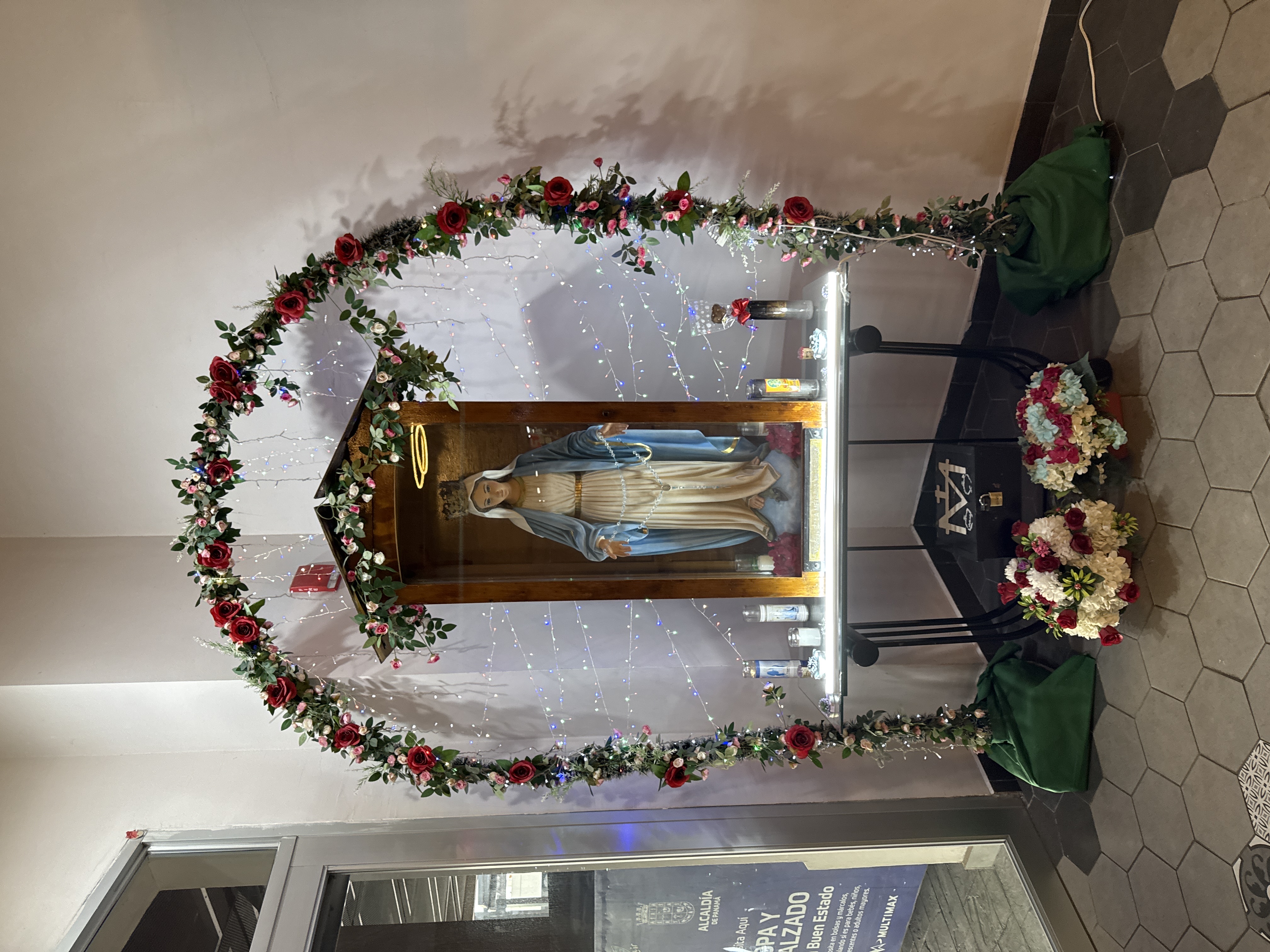
While it might seem surprising to encounter a religious shrine inside a commercial or administrative building like a bank or a government office, these "grutas" (grottoes) are a fundamental expression of Panamanian cultural identity. This particular installation honors the Virgin Mary, and it is common for employees and local residents to treat these spaces as active sites of devotion rather than mere decoration. You will often see fresh flowers, lit candles, and even small handwritten petitions placed at her feet, as she is viewed as a protector over the daily business conducted in the building.
The specific depiction here is Our Lady of the Miraculous Medal, identifiable by her open hands and the rays of light flowing from them, symbolizing the graces she sheds upon those who ask for them. The text nearby mentioning the "Alcaldía de Panamá" refers to the Mayor's Office of Panama City, which often coordinates with local businesses to maintain public service points. This explains why you might see signs for "Ropa y Calzado" (Clothing and Footwear) programs nearby; these are often charitable donation drives for "buen estado" (good condition) items managed by the city to help those in need, linking the spiritual presence of the shrine with the civic duty of the office.
The contrast of modern LED fairy lights and plastic floral arches against a traditional wooden tabernacle reflects a very Latin American "popular piety"—a blend of official Catholic doctrine with colorful, accessible, and heartfelt local traditions. For many Panamanians, the presence of the Virgin in a lobby is a reminder to act with integrity and compassion in their professional dealings, serving as a spiritual anchor in the midst of a busy urban environment.
Shrine to the Miraculous Medal in Santa Ana
The image depicts a roadside or alcove shrine to Our Lady of the Miraculous Medal (Virgen de la Medalla Milagrosa). In Panama, particularly in the Santa Ana district and Barrio Chino, such displays are common in commercial and public spaces—including banks like Banco Nacional—as a form of protection and spiritual patronage for the business and its patrons.
The iconography follows the 1830 visions of Saint Catherine Labouré: Mary stands on a globe, crushing a serpent under her feet, with rays of light (graces) descending from her hands. Local devotion often involves "promesas" (votive offerings or petitions) left at the foot of the statue. The presence of the "M" interlaced with a cross on the donation box below is the traditional monogram of the Blessed Virgin. While the geocoding identifies an ATM, the specific presence of this shrine highlights the seamless integration of Catholic piety into secular daily life in Panama, where religious icons often serve as unofficial "security" and community focal points.
Shrine of the Miraculous Medal
Shrine to the Virgin of the Miraculous Medal (La Medalla Milagrosa). Though located within a public or commercial building in Santa Ana, such displays are ubiquitous across Panama, merging Catholic devotion with civic life.
Distinctive features:
- **Iconography**: Recognizable by the Virgin Mary standing on a globe, crushing a serpent, with rays of light (graces) emanating from her open hands.
- **The Medal**: This specific devotion stems from 1830 Paris visions of Saint Catherine Labouré; the "M" interlaced with a cross shown on the donation box below is the reverse side symbol of the Miraculous Medal.
- **Votive Culture**: The candles (veladoras) and fresh flowers indicate active local "promises" (mandas)—offerings made in exchange for perceived miracles or protection.
- **Syncretism**: In high-crime or transit areas like Santa Ana, these shrines serve as "spiritual checkpoints" for safety. Locally, Maria is often viewed not just as a religious figure but as a maternal protectress against street violence and economic hardship.