UG
Ulrich Gall
The Illuminated Sentinel of Barrio Chino
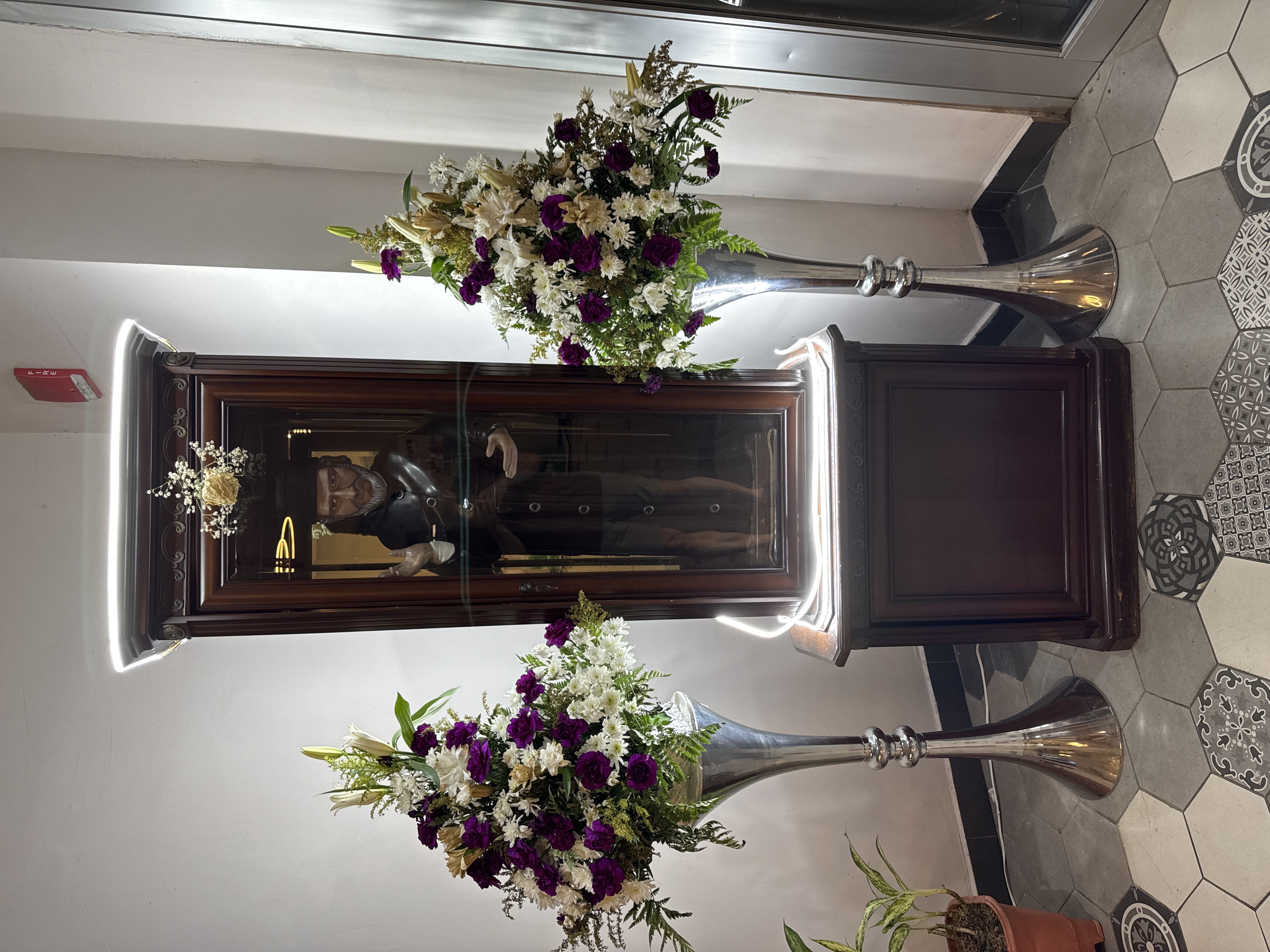
Here, in the heart of Panama’s Barrio Chino, we encounter a manifestation of the human urge to confront the infinite through the medium of polished wood and fluorescent illumination. We are looking at a glass-encased effigy, likely representing a saint or a fraternal figure of great solemnity, standing within a cabinet that suggests both a reliquary and a very expensive grandfather clock that has ceased to care about the passage of time.
Observe the figure. He gazes out with a look of profound, stoic resignation, as if he has seen the deepest recesses of the human soul and found it filled mainly with receipts and existential dread. He is flanked by two towering floral arrangements—explosions of purple and white that scream with a desperate, botanical vitality against the sterile white of the walls. These flowers represent a fleeting beauty, a frantic protest against the indifference of the universe, while the figure remains trapped in his glowing box, forever blessed and forever encased in glass.
The presence of such a shrine within a commercial or civic space like a bank branch in Santa Ana reveals a strange, haunting duality. It is the intersection of the divine and the transactional. Here, one may contemplate the salvation of their spirit while simultaneously worrying about the liquidity of their assets. It is a beautiful, terrifying spectacle of faith curated for the modern pedestrian, illuminated by a halo of LED light that does not so much grant holiness as it does provide a clear view of the dust motes dancing in the void.
The Guardian of the Bank
It is not every day that you find a 17th-century Spanish saint keeping watch inside a modern financial institution, but this is Don Bosco, and in Panama, his presence is a matter of profound national devotion. This life-sized statue, carefully encased and flanked by fresh floral arrangements, depicts Saint John Bosco, a mountain-born Italian priest who became the patron saint of the youth.
While the geocoding suggests this is a routine bank branch, the atmosphere here is shaped by a unique Panamanian tradition. In Panama, Don Bosco is more than just a religious figure; he is considered a guardian of the people, and his image is common in many secular spaces, including government offices and businesses. This particular statue is likely a point of veneration for local employees and visitors, who often stop to offer a quick prayer or a moment of reflection before going about their business.
The statue shows him in his traditional priestly robes, often characterized by a biretta (the stiff, three-peaked hat) and a gentle, welcoming expression. The devotion to "El Santo de la Juventud" (The Saint of Youth) in Panama peaked in the mid-20th century, particularly centered around the Don Bosco Basilica just a few streets away from here in the Calidonia and Santa Ana neighborhoods. Every January 31st, Panama City hosts one of the largest processions in the world in his honor, where tens of thousands of people fill the streets.
Seeing such an elaborate shrine in a lobby might seem unusual to a visitor from North America or Europe, where religious and commercial spaces are usually strictly separated. However, in Panama, the sacred and the profane often intermingle. The presence of the statue serves as a visible request for protection over the institution and its patrons. The LED lighting around the wooden cabinet and the silver vases indicate that this is not a forgotten relic, but an active, cared-for shrine that remains central to the daily cultural life of the neighborhood.
The Miraculous Saint Charbel in Panama
This figure is Saint Charbel Makhlouf, a 19th-century Maronite Catholic monk and hermit from Lebanon. He is a major religious phenomenon in Panama, particularly within the historic Santa Ana and Barrio Chino districts. While he was Middle Eastern, his cult of devotion has exploded across Latin America due to a reputation for miraculous physical healings.
In Panama, it is common to find him in secular or commercial spaces, reflecting a localized syncretic tradition where his presence is believed to offer protection and financial stability. Devotees often leave small ribbons or "petitions" near his image. He is easily identified by his black habit, cowl, and white beard. His remains in Lebanon are famously associated with "incorruptibility" and a mysterious viscous liquid called the "sweat of Saint Charbel," which was reported to exude from his body for decades after his death, fueling his global status as a "thaumaturge" (wonder-worker).
The Glass Shrine of Saint Philip Neri
This shrine is dedicated to Saint Philip Neri (San Felipe Neri), the "Apostle of Rome" and patron saint of laughter and joy. He founded the Congregation of the Oratory in the 16th century. His presence here is deeply tied to the adjacent Iglesia de San Felipe Neri, one of the oldest churches in Casco Viejo, dating back to 1688.
The figure is likely a "vested" statue, a common Spanish colonial tradition where religious icons are treated as living entities—bathed, dressed in real fabric garments, and kept behind glass to protect the delicate textiles from Panama's intense humidity. The silver-hued vases and LED lighting are contemporary local touches reflecting "popular piety," where community members maintain private or semi-public shrines to seek protection or favors.
While Neri is known for his humor, the somber, dark-clothed aesthetic of this specific representation follows a more formal penitential style typical of the Oratorians.