UG
Ulrich Gall
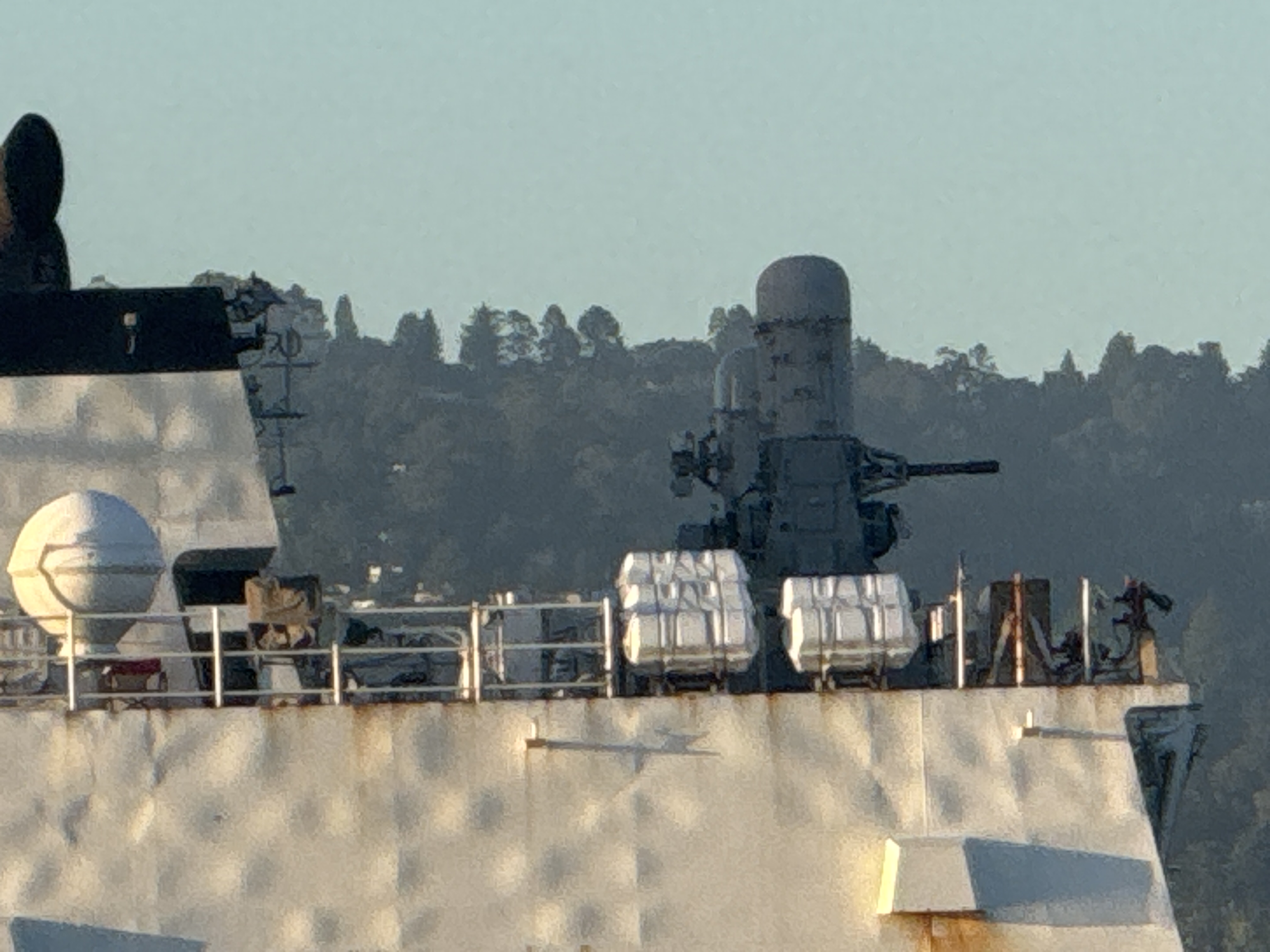
The Phalanx CIWS on a Coast Guard Cutter
Here, along the churning periphery of Alameda, we encounter a monument to our own collective paranoia. It is a vessel of the United States Coast Guard, perhaps the *Legend*-class cutter *Bertholf* or one of its kin, often found lurking in these grey, indifferent waters.
Observe the Phalanx Close-In Weapon System, or "CIWS." It stands atop the ship like a cyclopean, robotic penguin—a flightless bird of prey composed entirely of cold steel and calculating algorithms. Inside that dome, which we call a radome, there is a radar that does not see beauty or the shimmering of the tide; it sees only the encroaching oblivion of an incoming missile.
This device is the "last ditch" effort. When all other human diplomacy and long-range intervention has failed, this machine awakens. It possesses a 20mm M61 Vulcan rotary cannon, capable of spitting out several thousand rounds of tungsten per minute. It is a frantic, mechanical screaming against the silence of the sea. It does not think. It does not feel pity. It simply fills the air with a wall of lead, a desperate prayer to ward off a computerized death.
Below it, the white canisters sit in rows—life rafts. They are the fragile bubbles of hope, waiting to be cast into the abyss should the steel penguin fail in its grim duty. It is a strange juxtaposition: the instrument of total destruction sitting mere feet from the primary means of survival. The universe is indifferent to both.
The Navy's "R2-D2" Defense System
If you ever find yourself staring at a modern naval vessel and see something that looks like an oversized R2-D2 with a Gatling gun for an arm, you are looking at the Phalanx Close-In Weapon System, or CIWS. In the Navy, it is affectionately known as "R2-D2" because of its distinctive white radome and rounded top. This system is the final line of defense for a ship against incoming anti-ship missiles and aircraft. It operates entirely autonomously; using its own dedicated radar system, it can detect, track, and engage high-speed threats that have managed to penetrate all other layers of the ship's defenses.
The weapon itself is a 20mm M61 Vulcan rotary cannon, capable of firing up to 4,500 rounds per minute. What makes it particularly fascinating is that it doesn't just aim and fire; it "closes the loop" by tracking both the incoming target and its own outgoing tracers, continuously adjusting its aim in real-time until the target is destroyed. The white canisters you see lined up along the railing below it are life raft containers, designed to inflate automatically if they hit the water, providing a stark contrast between the ship's tools for destruction and its equipment for survival.
This particular vessel belongs to the United States Coast Guard, which maintains a significant presence in the San Francisco Bay Area. You might wonder why a Coast Guard ship—typically associated with search and rescue or drug interdiction—carries such heavy military hardware. These larger National Security Cutters are designed to be "interoperable" with the U.S. Navy. In times of conflict, they can be deployed alongside carrier strike groups anywhere in the world, serving functions nearly identical to a Navy frigate. The weathered, dimpled appearance of the ship's hull, which looks a bit like the surface of a golf ball, is a common phenomenon on large steel ships called "hungry horse." It occurs over time as the thin steel plating between the vertical internal frames deforms slightly due to the stresses of the sea and the welding process during construction. It serves as a visual reminder of the incredible physical forces these vessels endure while patrolling the open ocean.
The Phalanx "R2-D2" Defense System
The tall, dome-headed apparatus on this vessel is the Phalanx Close-In Weapon System (CIWS), often nicknamed "R2-D2" due to its distinctive shape. It is a rapid-fire, computer-controlled, radar-guided 20mm Gatling gun designed as a final layer of defense against incoming anti-ship missiles and aircraft.
Unlike most ship weaponry, the Phalanx operates autonomously; its internal radar searches for targets, evaluates threats, and fires up to 4,500 rounds per minute to shred projectiles before they can impact the hull. This specific ship is a Legend-class National Security Cutter of the U.S. Coast Guard, which utilizes the CIWS for high-threat environments. The white canisters nearby are inflatable life rafts, designed to deploy automatically if the ship sinks.
Phalanx CIWS "R2-D2" Naval Defense
Phalanx Close-In Weapon System (CIWS), nicknamed "R2-D2" for its dome shape. This is a rapid-fire, radar-guided 20mm M61 Vulcan gatling gun used by the U.S. Navy as a point-defense system. Its purpose: destroying incoming anti-ship missiles and "kamikaze" threats at short range. It operates autonomously, using search and track radars to detect, prioritize, and engage high-speed targets with tungsten armor-piercing rounds—firing at a rate of up to 4,500 rounds per minute.
The vessel is likely a Legend-class National Security Cutter (NSC) operated by the U.S. Coast Guard, frequently docked at Coast Guard Island in the Oakland/Alameda estuary. While the Coast Guard focuses on maritime law enforcement and search and rescue, these heavy cutters are equipped for high-threat environments, including drug interdiction missions in the Eastern Pacific where they may encounter hostile "low-profile vessels" or "narco-subs." The "oil canning" or wavy texture on the hull is typical of modern thin-plate steel construction, where welding stress causes slight buckling.