UG
Ulrich Gall
The Resilience of Comuna 13
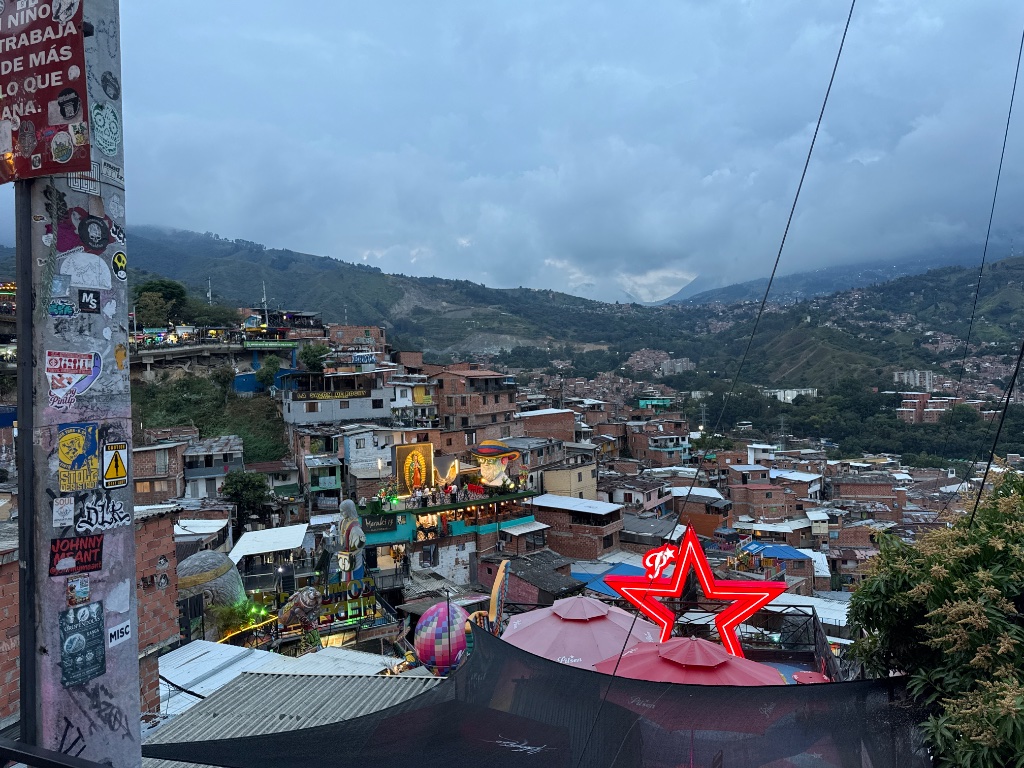
The vibrant landscape before you is a testament to one of the most radical urban transformations in modern history. This is Comuna 13, a district in Medellín that was once considered the most dangerous neighborhood in the world during the 1990s and early 2000s. Today, it has reinvented itself as a global center for street art, music, and social innovation.
One of the most unusual sights here is the presence of high-tech infrastructure integrated into the steep, informal mountainside housing. The orange-roofed structures and complex network of paths are part of a massive social project that includes a series of outdoor escalators. Before these were installed, residents had to climb the equivalent of 28 stories of stairs just to reach their homes or commute to work. By making the neighborhood accessible, the city effectively ended the isolation that allowed gangs and cartels to thrive.
The area is deeply spiritual and culturally expressive, which explains the large, glowing icon of the Virgin of Guadalupe visible on one of the rooftops. She is a powerful symbol of protection in Latin America, and her presence here overlooking the valley serves as a beacon of hope for a community that has survived decades of conflict. You’ll also notice the "Cerveza Pilsen" star—a ubiquitous sight in Medellín, as Pilsen is the city's most iconic local beer and a staple of social life in the comunas.
The stickers and graffiti covering every available surface, like the pole in the foreground, aren't just "street art"; they are historical markers. Many of the murals and messages here tell the stories of the *desaparecidos* (the disappeared) or celebrate the "Berraquera"—a local term for the incredible grit and determination of the people of Medellín. Even the signage, such as the note on the pole that mentions *"Niño trabaja de más"*, often touches on social themes, reflecting a community that is constantly negotiating its identity and advocating for its youth. What you are seeing is essentially an open-air museum detailing the triumph of community spirit over a violent past.
Comuna 13 Social Urbanism
Comuna 13 was once considered the most dangerous neighborhood in the world, serving as a strategic corridor for paramilitary, guerrilla, and cartel groups due to its location on the edge of Medellín. The district underwent a radical transformation following *Operación Orión* in 2002, a controversial military raid aimed at ousting urban militias which resulted in numerous civilian casualties and disappearances.
Today, the area is a global model for "social urbanism." The orange-roofed brick homes are connected by a massive outdoor electric escalator system—the first of its kind in a poverty-stricken area—which replaced 350 steep concrete stairs and integrated the isolated hilltop community into the city's economy. Much of the vibrant street art serves as a memorial to the neighborhood's violent history; for instance, many murals feature white cloths or birds, symbolizing the call for peace that residents made during the 2002 conflicts.
The large red star belongs to Pilsen, a popular local beer brand, and stands atop a terrace overlooking the "Independencias" sector. This area is now a hub for hip-hop culture, which emerged as a non-violent alternative for youth to express their experiences and resist gang recruitment.
Comuna 13’s Radical Transformation
Comuna 13: once the most dangerous neighborhood in the world, now a hub of "social urbanism." Formerly controlled by Pablo Escobar’s Medellin Cartel, then paramilitaries and guerrillas.
The neon red star marks a social space near the **Escaleras Eléctricas** (outdoor electric escalators). Installed in 2011, these six sections replaced 350+ steep concrete stairs, cutting a 30-minute climb to six minutes—a global model for integrating marginalized hilltop slums.
Note the heavy graffiti and street art; this isn't just decoration but "Artistic Resistance," documenting the 2002 **Operation Orion**, a bloody military raid involving 1,000+ troops and helicopter gunships that left many "disappeared" in the nearby La Escombrera landfill.
Today, the area thrives on "Narco-tourism" and hip-hop culture. While safe for tourists, localized extortion (vacunas) by gangs (*combos*) still exists behind the colorful facades.