UG
Ulrich Gall
The Eighth Station of Jericó
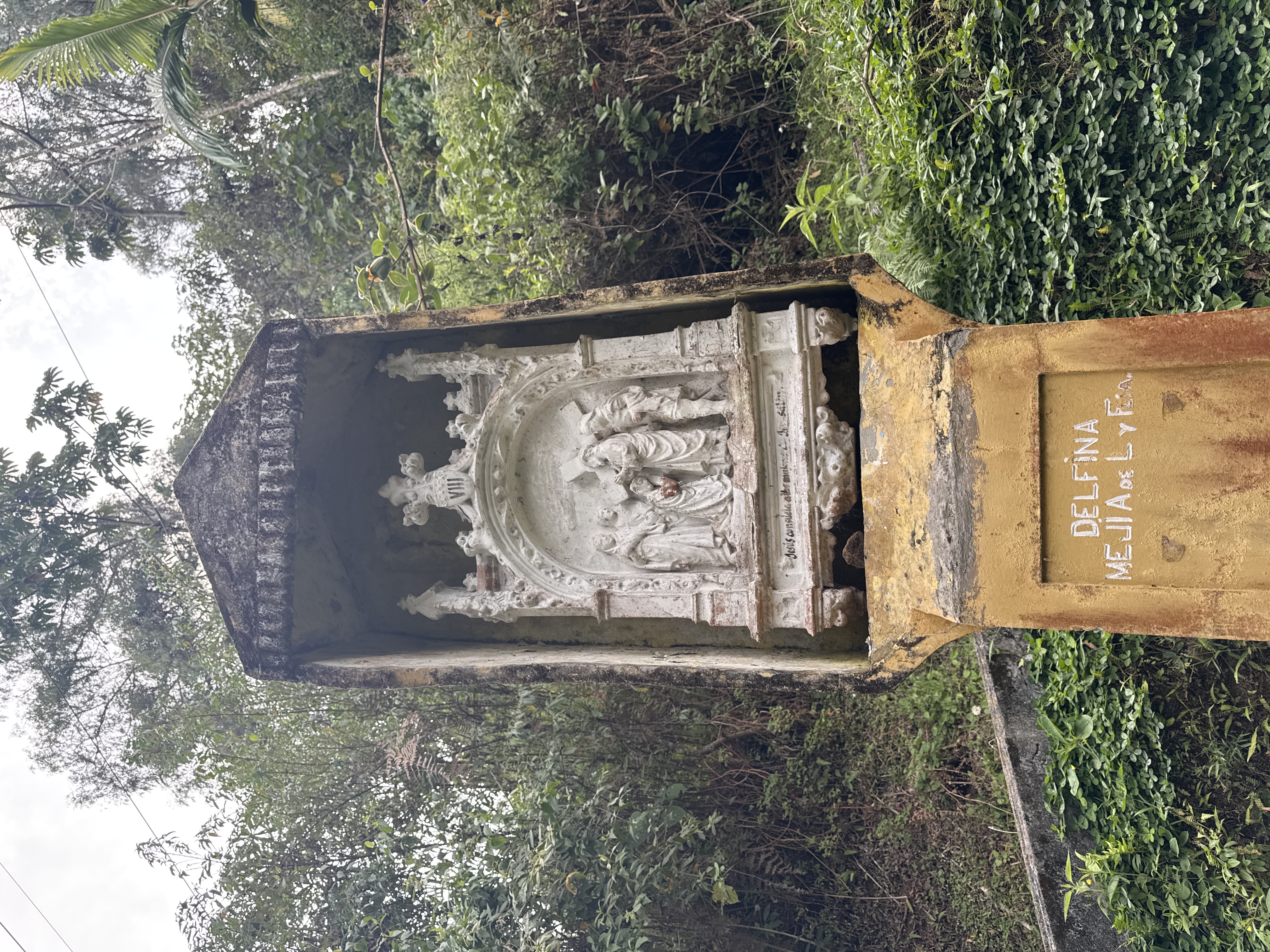
Here, in the colossal, indifferent greenery of the Colombian Andes, we find a curious manifestation of human longing. This is the Eighth Station of the Cross, a singular monument perched on the path toward the Cristo Rey atop the hills of Jericó. Look closely at the sculpted relief: it depicts Jesus, burdened by the heavy timber of his own demise, pausing to console the weeping women of Jerusalem. It is a moment of profound, existential sorrow, rendered in plaster and stone, surviving the relentless humidity of the cloud forest.
The craftsmanship is ornate, almost defiant in its fragility against the overwhelming chaos of the jungle. It is housed within a weather-beaten concrete alcove that bears the name "Delfina Mejia de L. y Fia," a silent testament to a family’s devotion—or perhaps their attempt to carve a small, ordered space into the vast, churning landscape of Antioquia. The number eight is visible at the apex, marking a specific stage in a ritualistic journey of suffering that pilgrims undertake while climbing these steep, verdant inclines.
While the surrounding flora grows with a murderous intensity, this small shrine stands in quiet contemplation of a 2,000-year-old tragedy. It is a strange collision of the eternal and the terrestrial; the divine message sits encased in a shell that is slowly being reclaimed by lichen and the damp breath of the mountains. One must wonder if the figures in the relief are aware of their solitude, here where the air is thick with the scent of coffee and the prehistoric indifference of the trees.
The Eighth Station of Jericó
High in the verdant mountains of Antioquia, small roadside shrines serve as both spiritual landmarks and historical markers for the local "Paisa" culture. This specific stone structure is the eighth station of a "Via Crucis," or Way of the Cross, a series of fourteen depictions of Jesus on the day of his crucifixion. The Roman numeral "VIII" at the top confirms its sequence, and the Spanish inscription below the relief—"Jesús consuela a las mujeres de Jerusalén"—translates to "Jesus consoles the women of Jerusalem."
What makes these shrines particularly interesting in this region of Colombia is that they are often privately sponsored and dedicated to prominent local figures. The inscription at the base, "Delfina Mejia de L. y Fia.," refers to Delfina Mejía and her family (indicated by the "y Fia.," an abbreviation for "y Familia"). The Mejía family is one of the foundational and highly influential lineages in Jericó. This town is famously known as the "Athens of Southwest Antioquia" due to its rich cultural, religious, and architectural heritage. It is the birthplace of Santa Laura Montoya, Colombia’s first saint, which explains why the deep-seated Catholic faith is so physically manifested in the landscape through monuments like this.
In rural Colombia, these stations are not just for aesthetic purposes; they often define a pilgrimage route. During Holy Week (Semana Santa), hundreds of locals and travelers walk these steep mountain roads, stopping at each shrine to pray. The weathering on the concrete housing and the moss creeping up the yellow pedestal highlight the humid, tropical Andean environment, where the jungle constantly tries to reclaim these man-made testimonies of faith.
The VIII Station of the Cross, Jericó
These roadside shrines, known as *animitas* or *nichos*, are ubiquitous in the Colombian Andes. This specific structure represents the VIII Station of the Cross (indicated by the Roman numeral): "Jesus consoles the women of Jerusalem." It is part of a larger series located along the ascent to the Cerro Salvador hill in Jericó, a town designated as one of Colombia’s "Pueblos Patrimonio" (Heritage Towns) due to its deep religious architecture and history.
Jericó is the birthplace of Santa Laura Montoya, Colombia's first saint, which drives a significant pilgrimage culture. While some roadside shrines in Colombia mark the site of fatal traffic accidents, these specific "Stations" serve as a communal "Via Crucis" (Way of the Cross). Local families or prominent citizens often sponsor individual stations; the name "Delfina Mejia de L. y Fia." inscribed at the base identifies the patron who funded this specific monument.
The reliefs are typically made of cast plaster or cement and are maintained by the community to ensure spiritual protection over the mountain path. In rural Antioquia, such landmarks serve a dual purpose: they facilitate physical rest during steep climbs and provide a localized site for prayer in areas where the nearest church might be miles away.
Station VIII of the Jericó Via Crucis
Station VIII of the *Via Crucis* (Way of the Cross) on the path to the Morro el Salvador in Jericó. This relief depicts "Jesus consoles the women of Jerusalem." Jericó is one of Colombia’s *Pueblos Patrimonio* (Heritage Towns) and a deeply conservative Catholic stronghold. It is the birthplace of Laura Montoya, Colombia's first saint.
These trailside shrines, or *animitas*, serve a dual purpose: devotional pilgrimage and memorialization. The name "Delfina Mejia de L. y Fia." indicates a donor or a soul being commemorated. In Antioquia, such "animitas" are often believed to bridge the gap between Purgatory and the living; locals offer prayers in exchange for protection or favors (*milagros*). The proximity to the highway isn't accidental; they act as spiritual safeguards for travelers navigating treacherous Andean mountain roads, where fatal accidents are historically common.