UG
Ulrich Gall
The Leather Craft of Jericó
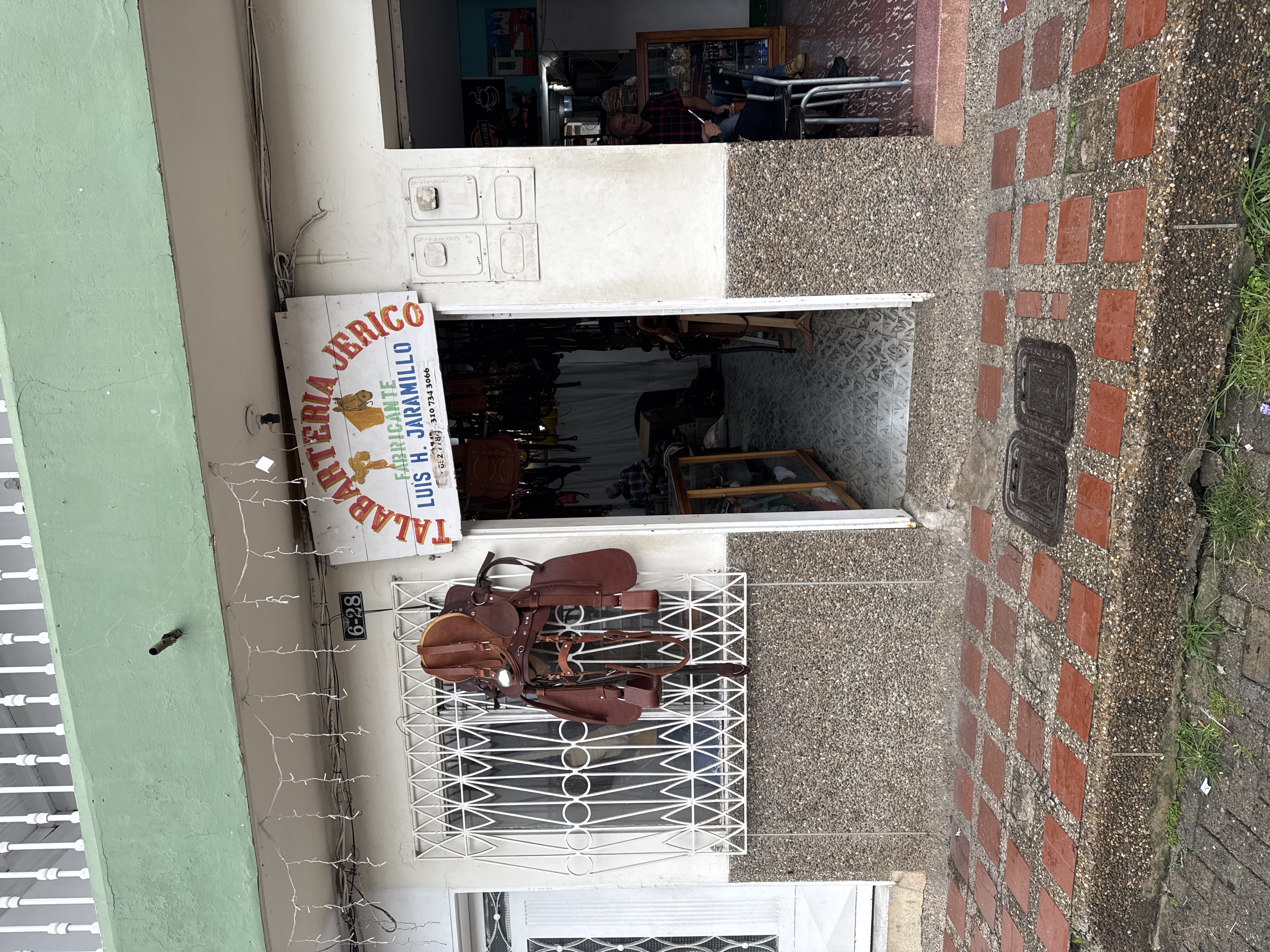
The art of traditional leatherworking is the beating heart of Jericó, a town often considered the most beautiful in the department of Antioquia. The sign reading "Talabartería Jericó" identifies this as a saddlery and harness shop, where a master "fabricante" or manufacturer like Luis H. Jaramillo continues a legacy that has defined this region for generations.
Jericó is the birthplace of the *carriel*, the iconic side-slung leather bag worn by the *Paisa* muleteers who settled these rugged mountains. While the carriel is the town's most famous export, the skills required to make them are the same ones used here for equestrian gear. The large leather piece hanging on the security bars is a testament to the local "Chalanería" culture—the refined Colombian art of horsemanship. Unlike the heavy western saddles found in North America, these local saddles are designed for the "Paso Fino" horses, known for their smooth, rhythmic gait.
Inside a "Talabartería," you are smelling history. The process begins with raw hides that are tanned and then meticulously hand-tooled, stitched, and finished. If you peek into the shadows of the workshop, you’ll likely see rolls of leather and heavy-duty sewing machines, but much of the fine detail work is still done by hand with awls and needles.
The presence of such shops in the middle of a modern town might seem unusual to a visitor, but in the coffee-growing heartland of Colombia, horses remain both a practical tool for farmers in the steep mountains and a major status symbol. A shop like Luis Jaramillo’s isn't just a retail space; it’s a craft hub where the identity of the Antioquian muleteer is kept alive, one stitch at a time.
The Leather Legacy of Jericó
Jericó is the birthplace of the **carriel**, an iconic leather satchel synonymous with Antioquian "Paisa" culture and the region's historical muleteers (*arrieros*). Traditional saddleries, or *talabarterías*, handcraft these bags using a complex process that involves up to 12 secret internal compartments, historically used by traveling merchants to hide gold coins, tobacco, and charms.
The town remains a premier hub for high-quality leatherwork due to its proximity to the region's historic cattle-driving routes. The saddle hanging outside reflects the specific needs of the Colombian Paso Fino horse; unlike Western saddles, these are narrower and deeper to accommodate the horse’s unique four-beat lateral gait, which provides a smooth ride over steep, uneven Andean terrain. This craft is so central to local identity that Jericó is often referred to as the "Athems of the Southwest" for its preservation of these colonial-era manual arts.
The Secrets of the Carriel Antioqueño
Traditional leather workshop (talabartería) in Jericó, famous for the *Carriel Antioqueño*. Jericó is one of Colombia's "Pueblos Patrimoniales" and the national capital of high-quality saddlery and leatherwork.
Key Discovery: The *Carriel*. Look closely at the leather satchel hanging—it’s the iconic accessory of the *arriero* (muleteer). Authentic Jericoano carriels are unique for their hidden compartments (up to 12 or more) historically used by muleteers to hide gold, tobacco, letters, and "protection" (charms or small weapons).
Technical Specs:
* **Materials:** Rawhide with fur left on (usually cow or calf), often featuring bright yellow, orange, or green stitching.
* **The "Secret" Pockets:** Designed with false bottoms called *secretas* to prevent theft during long mountain treks.
* **Cultural Status:** Declared Cultural Heritage of the Nation.
This specific shop, belonging to Luis H. Jaramillo, represents the diminishing artisan tradition where saddles and carriels are still hand-stitched using techniques unchanged for over 150 years.