UG
Ulrich Gall
A Taste of the Antioquian Countryside
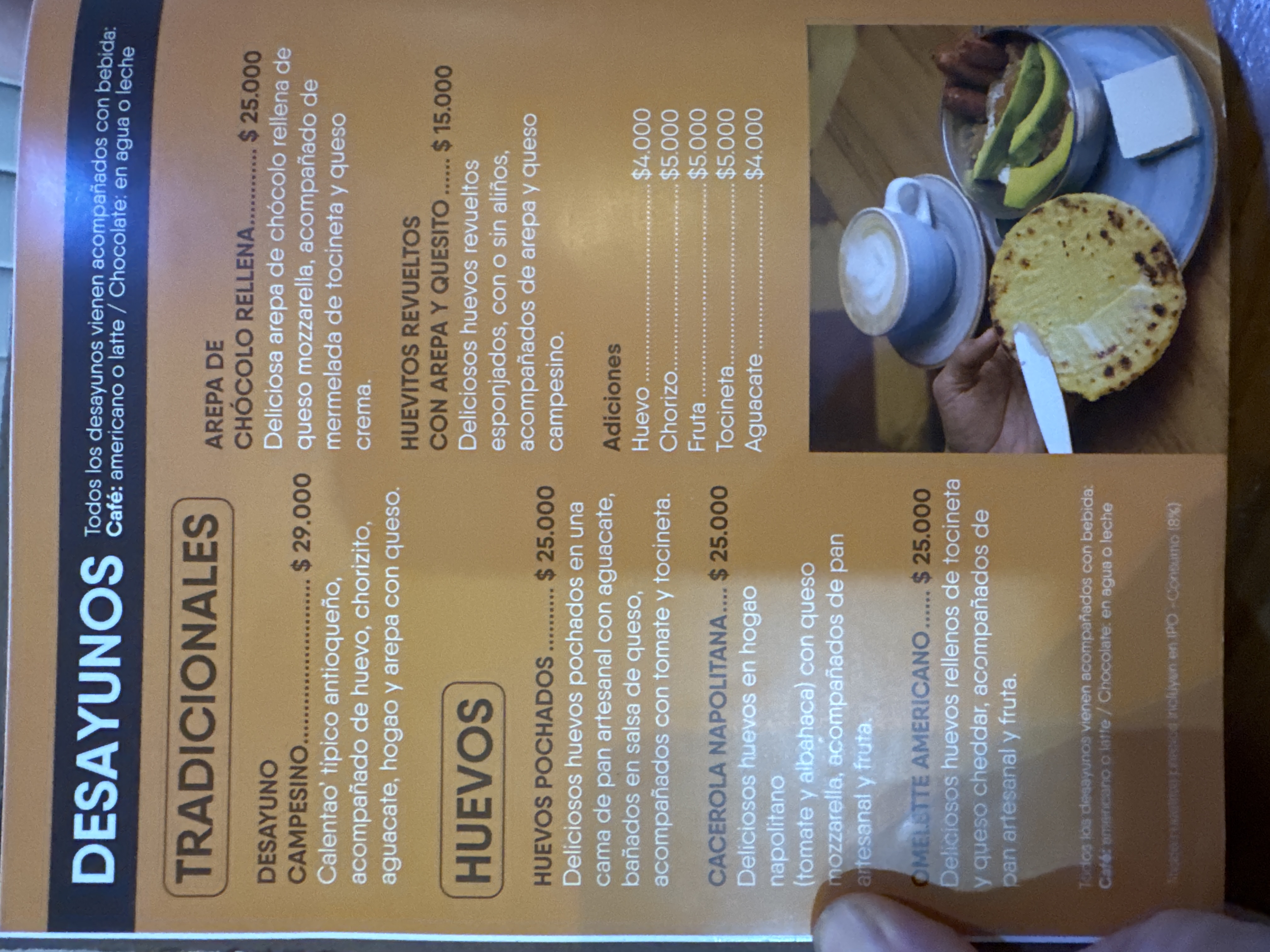
While this breakfast menu looks familiar in its layout, it offers a window into the hearty culinary identity of the Antioquia region, where breakfast is traditionally the most substantial meal of the day to fuel hard work in the mountains. The standout item here is the "Desayuno Campesino," or Country Breakfast. It features "Calentao," a beloved Colombian staple that literally means "heated up." Historically, this was a way to make sure no food went to waste by frying up last night’s beans and rice together the next morning. In this region, it is elevated with "hogao," a savory, slow-cooked Creole sauce made of tomatoes and green onions that forms the flavor base of almost all Colombian cooking.
You might notice the prominent mention of the "Arepa de Chócolo." While many Westerners are familiar with the standard white corn arepa, the "chócolo" version is made from tender, sweet yellow corn. It has a much softer, almost pancake-like texture and a natural sweetness that creates a perfect contrast when stuffed with salty, melted mozzarella cheese. Another local specialty listed is "Quesito," a fresh, pressed curd cheese that is very soft and mild, often served in a thick slice alongside eggs.
If the prices seem startling at first glance—such as 29,000 for a breakfast—it is important to remember that these are in Colombian Pesos (COP). In this context, that price is quite reasonable for a hearty meal including a drink. Speaking of drinks, the menu notes that all breakfasts come with a choice of "Café" or "Chocolate." In Colombia, hot chocolate is a breakfast cornerstone often prepared with water or milk and, traditionally, a piece of salty cheese is dropped into the mug to melt at the bottom. The "aliños" mentioned under the scrambled eggs refer to a seasoning mix of finely chopped vegetables, typically onions and peppers, which adds a savory depth to the dish.
The Paisa Breakfast Tradition
Jericó is the birthplace of Santa Laura Montoya, Colombia's only saint, and sits in the heart of the "Paisa" region. The regional culinary staple featured here is the *Arepa de Chócolo*. Unlike the white, savory corn arepas common elsewhere, this is made from tender, sweet yellow corn (chócolo), resulting in a pancake-like texture that is traditionally paired with salty *quesito*—a fresh, pressed curd cheese—to balance the sugar.
The *Desayuno Campesino* features *Calentao’*, a "heated up" breakfast tradition rooted in rural poverty. Historically, mountain laborers (arrieros) could not afford to waste food, so dinner leftovers—typically beans and rice—were fried together the next morning to provide high-calorie fuel for farm work. This is served with *Hogao*, a foundational Colombian savory sauce made by sautéing long green onions and tomatoes.
Prices are listed in Colombian Pesos (COP). A breakfast priced at $25,000 COP is approximately $6.50 USD. The "IPO-Consumo (8%)" at the bottom refers to the *Impuesto Nacional al Consumo*, a selective consumption tax applied to bars and restaurants instead of the standard VAT (IVA).
Antioquian Breakfast Staples
Calentao’ (seen in the *Desayuno Campesino*) is the quintessential "recycled" breakfast of Antioquia—literally "heated up" leftovers from the previous night's dinner, typically rice and beans (fríjoles), sautéed with hogao. Hogao is a savory Creole sauce made of tomato and long green onions.
Key regional variations include the **Arepa de Chócolo**, distinguishable from standard white corn arepas by its use of sweet, tender yellow corn, giving it a pancake-like consistency and sweeter profile. The **Quesito** mentioned is a fresh, pressed white cheese with a mild, salty finish, distinct from the aged cheeses common in the West.
The prices are in Colombian Pesos (COP). High numbers (e.g., $25,000) reflect local currency valuation; roughly $6 USD. Note the **8% IPO (Impuesto al Consumo)** mentioned at the bottom; this is a standard indirect tax on bars and restaurants in Colombia, often replacing or appearing alongside small service tips (*propina*), which is usually an optional 10% added to the final bill.