
Eddie Codel
The Seaman’s Monument of Hellissandur
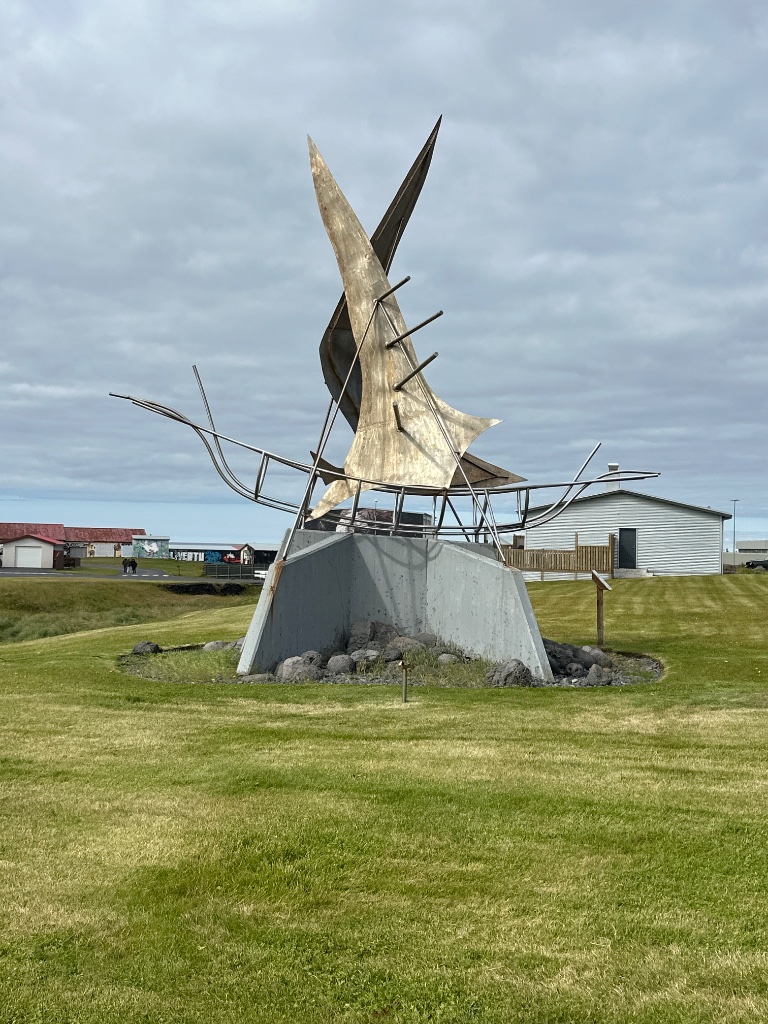
This striking abstract sculpture, known as *Sjómannaminnismerkið* or the Seaman’s Monument, serves as a powerful tribute to the local fishermen who lost their lives at sea. Located in the small village of Hellissandur on the Snæfellsnes Peninsula, the piece was created by the renowned Icelandic artist Ragnar Kjartansson. Its jagged, sail-like forms and skeletal frame capture the raw intensity of the North Atlantic, a force that has shaped the history and soul of this community for centuries.
While the sculpture looks like a modern artistic expression, it is deeply rooted in the practical and dangerous reality of Icelandic coastal life. Hellissandur was once one of the most important fishing hubs in Iceland, dating back to the 16th century. For generations, the men of this village headed out into some of the most treacherous waters in the world in open wooden boats. The monument’s design, with its sharp angles and upward momentum, evokes the image of a ship struggling against the waves or a soul rising from the depths.
In the background, you might notice vibrant splashes of color on the buildings. Hellissandur has recently become famous as the "Street Art Capital of Iceland." What used to be a quiet fishing village is now home to over 30 large-scale murals painted by artists from around the world. One of the visible murals contains the word *Lívertú*, which refers to Liverpool. This is a nod to the historical "Liverpool" house in the village, named by a local merchant who had strong trading ties with the English city in the 19th century.
This juxtaposition of a somber memorial to the sea and a modern, colorful street art scene encapsulates the spirit of modern Iceland: a place that fiercely honors its rugged, often tragic history while embracing a creative and global future. Standing here, you are at the edge of the Snæfellsjökull National Park, where the sea and the glacier meet, creating an environment that is as inspiring as it is unforgiving.
Jökull: The Hellissandur Fisherman's Monument
This sculpture is "Jökull" (The Glacier), created in 1989 by Icelandic artist Ragnar Kjartansson (the elder). It stands as a monument to the fisherman of Hellissandur, a village that was once a primary fishing hub for the Snæfellsnes Peninsula.
The abstract form is crafted from stainless steel and bronze. Its sharp, angular geometry is designed to evoke several local motifs simultaneously: the silhouette of the nearby Snæfellsjökull glacier, the sails of historical fishing vessels, and the aggressive, wind-swept nature of the North Atlantic. The concrete base mimics a ship’s hull or a breakwater, grounding the ethereal metal "sails" against the harsh Icelandic elements. Hellissandur itself transitioned from a major 16th-century fishing port to a quiet village, and this piece serves as a modernist link to that maritime heritage.
The Iron Boat of Hellissandur
Monument to the Fishermen by Jóhannes S. Kjarval (design) and Ragnar Kjartansson (realization). Located in Hellissandur, once the fishing capital of the Snæfellsnes peninsula.
The sculpture depicts a stylized, abstract fishing boat braving heavy Atlantic swells. It honors the dangerous history of rowboat fishing in these waters, where many locals perished. Hellissandur was one of Iceland's oldest fishing stations, dating back to the 13th century.
Interesting detail: The design originated from a drawing by Kjarval, Iceland's most beloved painter, who was actually born in this area. It reflects the "Icelandic soul"—a constant struggle against the brutal elements of the North Atlantic. The nearby Maritime Museum further documents the transition from these fragile wooden boats to motorized vessels that revolutionized the local economy but ended a centuries-old way of life.